Ice Climbing at Fox

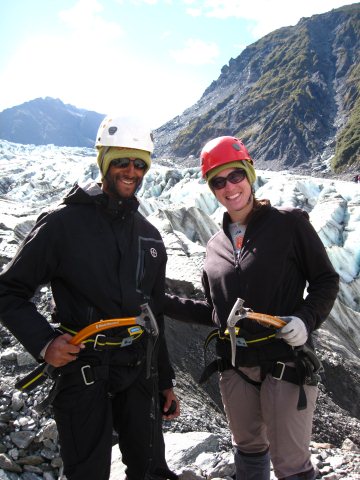
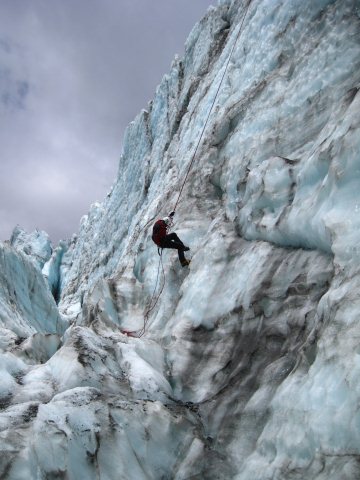
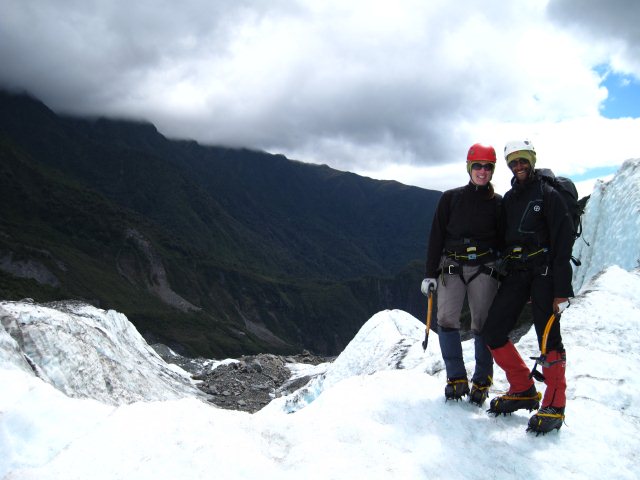
Ice climbing! We met with our Fox Glacier guide at 8am. After gathering our equipment it was a short bus ride to the glacier before we set off on foot. The hike up was probably the toughest part of the day. It was a long slog getting up to the glacier. Some parts of it were so steep that the only way up was literally one foot after another. There wasn’t any running up this thing, not even with the 12 spike crampons we had on each foot. The most dramatic parts of the glacier were at the top so that’s where we were heading. Sam, our fantastic guide and climbing instructor, had us stop a few times so he could fill us in on ice climbing techniques and show us how the equipment works. We practiced techniques like ducking, walking downhill, walking laterally across a slope, climbing a vertical ice wall with just the crampons, climbing with crampons and two ice axes, climbing with crampons and a single axe, traversing horizontally, pretty much everything there is. We were well prepared when Sam picked the first climbing spots.
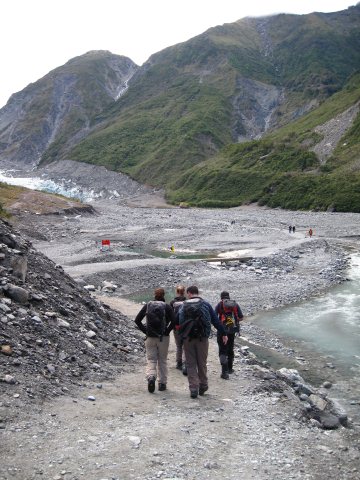
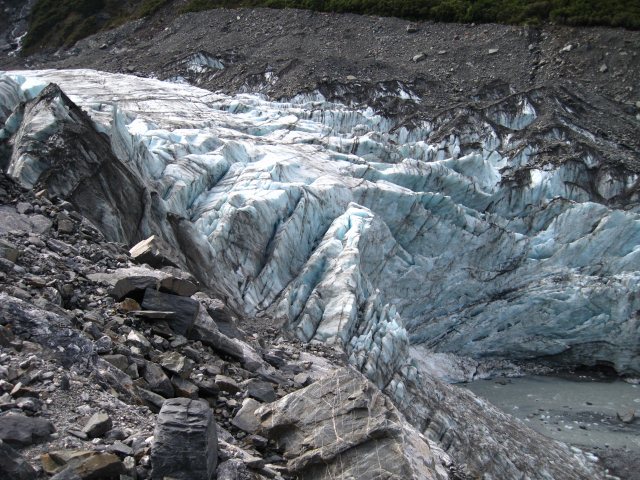
 Walking up the glacier was exceptionally cool. It’s the sort of environment I’ve had no exposure to so everything I was seeing was new. Sudden drops in the ice, huge crevasses, soaring peaks that appeared very suddenly (so much of what you see is obscured until you’re right in front of it), huge rocks and boulders from the adjacent valleys (a result of the frequent landslides), danger lurked around every corner. We were glad to have Sam with us. The changes in terrain were very sudden and oftentimes very dramatic. It’s what I’d imagine Earth looked like during its infancy, only with the ice replaced by rock. Everything was so volatile, so unpredictable, there was a lot of uncertainty about the terrain. It was constantly changing, both being formed and destroyed. Sometimes before our very eyes. Because of the unique shape and environment of the Fox and Franz Joseph glaciers, they move at a rate roughly 10 times faster than other valley glaciers around the world. The glacier terminus was noticeably different when we were heading back into town only 9 hours after we had first seen it. Large chunks of ice had fallen off and landed in the river leading away from it. Sam was telling us that sometimes huge house or office building sized chunks of ice fall off, blocking the entire river. The pressure behind the resulting ice dam builds and builds, becoming greater with each passing hour. It builds until the pressure is so strong that it smashes through the ice, creating a violent and unstoppable surge of icy water so big and fast moving that no one could hope to out run or survive it. The last one, only a few years ago, was 35 metres wide and 15 metres high. A person would have no chance. We actually saw a really big rock slide on the adjacent rock face as we were leaving. Thankfully, we were nowhere near it but the sound it generated was thunderous. And not the puny thunder we get in England either, huge, wrath of God thunder, like the world was coming to an end.
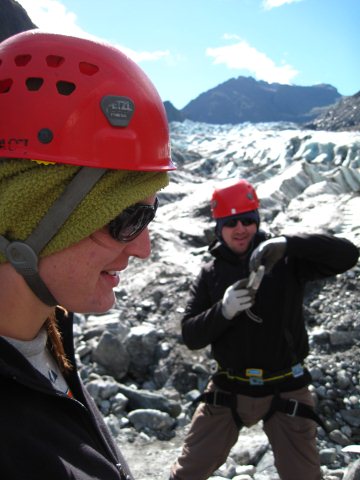
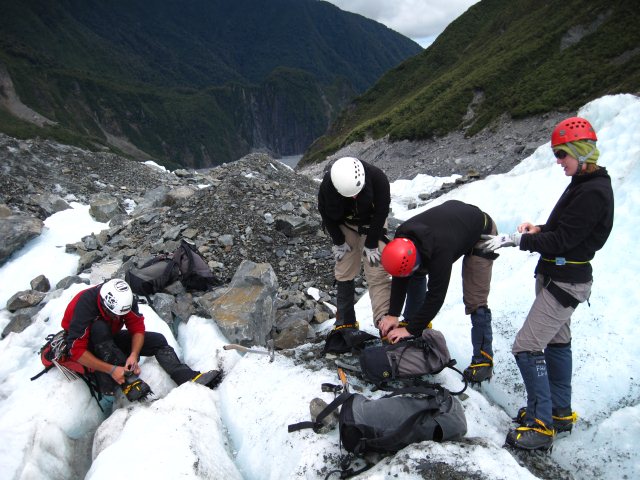
The first climbing spots. Sam started us off slow. It felt very strange kicking something as hard as ice and having two small spikes on the front of your foot support your entire body weight. Getting the technique for the ice axes right was strange too. Flicking your wrist correctly at the end of each swing was the difference between your axe going into the ice and you missing your hold and falling. We understood it quickly because Sam was such an excellent teacher. The first two spots were very straight forward, we didn’t really even need rope to climb them. They were each about 7 metres up and we made short work of them. The next two though were a different story. One was a 25 metre, completely vertical climb with no breaks in the path. All up, all the time, the starting point was a narrow piece of ice with a long drop on the other side. The other, also a 25 metre climb, had a large overhang at the start, you had to overcome this only to be faced with a seriously demoralising metre deep, metre wide break in the path. The only way up was to climb onto the narrow ice ledge at the top of the first part of the wall (being careful to maintain your balance), and using all of your energy to leap over the gap, violently digging your crampons and ice axes into the second ice wall upon contact to continue the climb. After this gruelling effort there was still two thirds of the wall to go. Only, this section had even more overhangs and weaker ice to boot. Climbing it was a physical and mental challenge. In our group of four, I was the only one to successfully scale this wall.
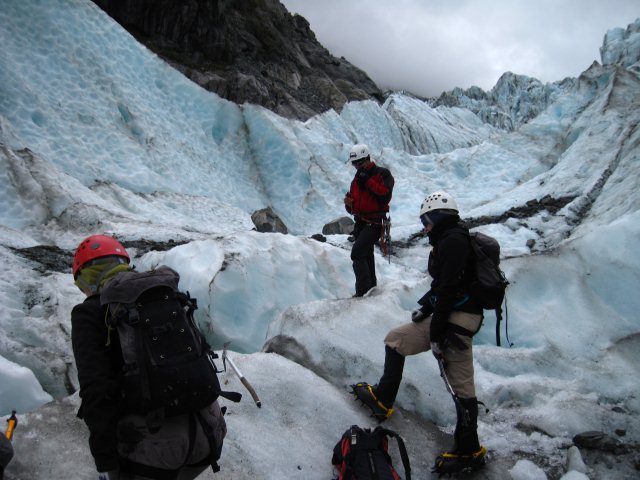
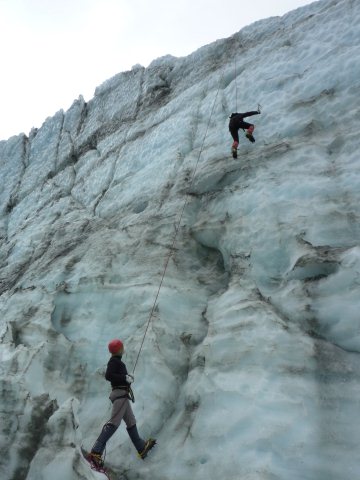
When we were done with those climbs it was around 4:30pm, we started back towards the glacier terminus so that Sam could show us (and lower us down into) a cool sounding crevasse. We’d been in a couple of small ice caves already, one before we even did any climbing but this sounded entirely different. It was about 5 when we were back and Sam had set up the safety system to lower us in. I was the first one in. Just like before, I hooked myself up to the rope and put all my weight back onto the harness. I had both feet up against the ice wall and an ice axe in each hand. Sam slowly fed me more rope as I went down deeper into the ice. I turned my gaze downward and saw how long a drop it was. Now, the last two climbs were really high up, at the top, even half way up, you felt very far from the ground. From that height a fall would likely have meant death or at the very least serious injury. Someone with a fear of heights would probably have been paralysed if they were up there and decided to look down. This though, a fall into this crevasse was certain death. It was a long, possibly 30 metre drop with sharp, jagged rocks at the bottom. It narrowed quite a lot during the descent too, claustrophobics would not have been happy. I decided to look down as I went but it didn’t help me feel better about things so I stopped doing that before long. I let Sam lower me about half way down before telling him I’d had enough. That wasn’t the end though, I still had to climb out and it would not be easy. The ice here was different to what I’d seen so far. The outer layer was very thin and brittle so I was having to kick my boots in really hard. Sore isn’t even the word for how my toes felt afterwards. I was using all my energy to keep my arms going, the axes just weren’t staying in the wall. It was a slow, painstaking process getting back out of that cave. I breathed in a deep sigh of relief when I was on (relatively) solid ground again.
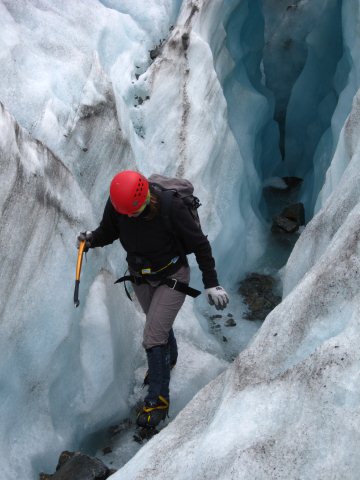
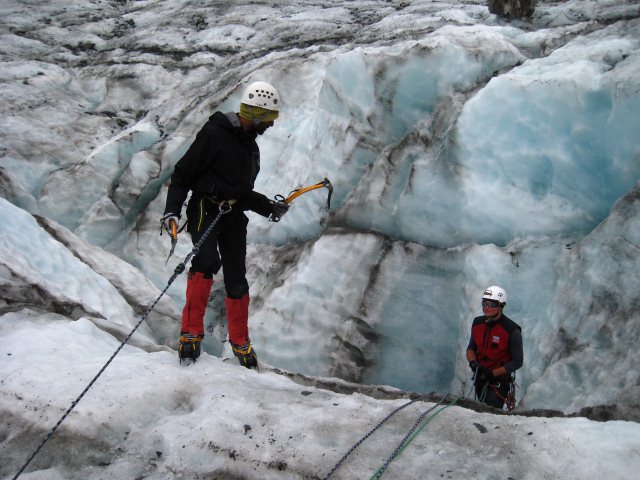
The hike back to the very beginning of the path, down over the stones and boulders, rock hopping over the two small rivers we’d crossed in the morning was unsurprisingly, much more enjoyable downhill than it was up. During that hike back I realised that I enjoyed ice climbing even more than I love scuba diving. It sucks that this is probably going to be an even more expensive hobby to maintain.
Bungy Jump!

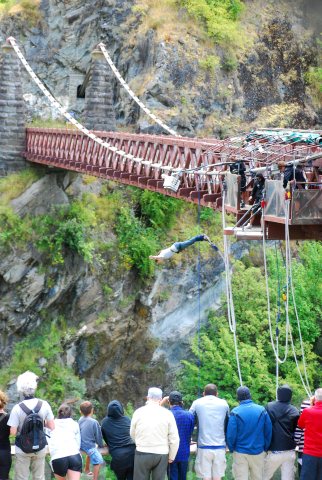
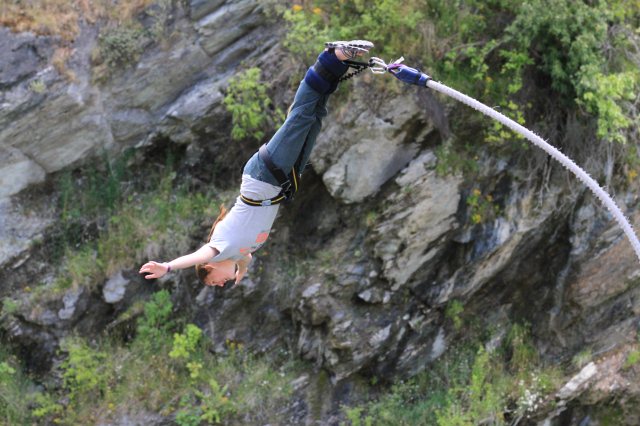
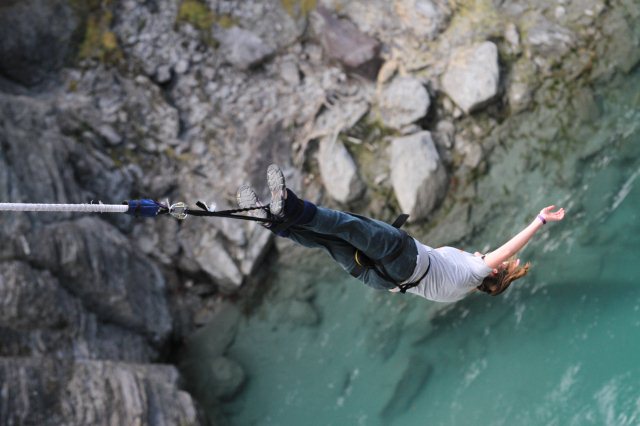
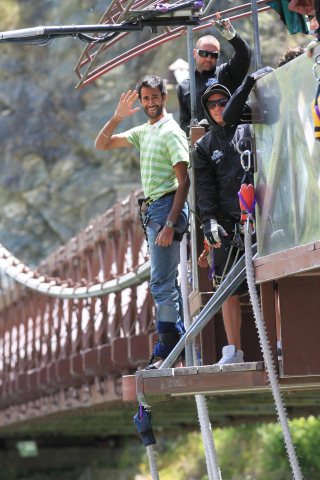
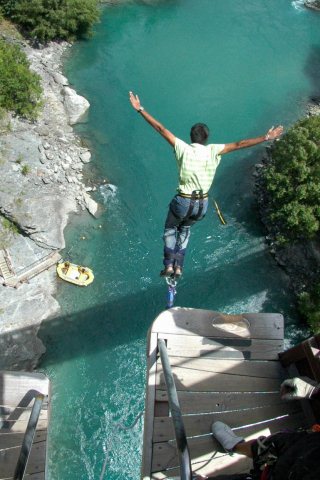
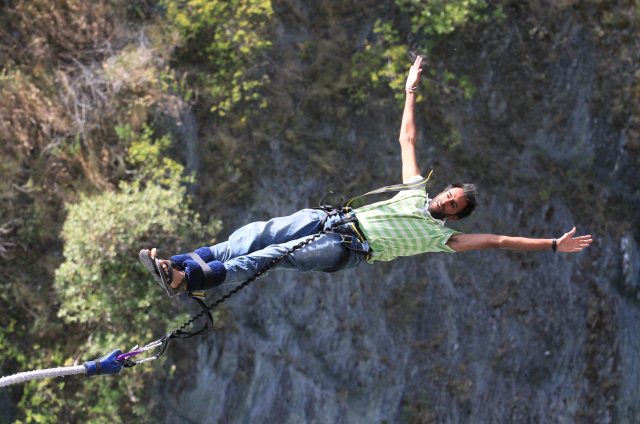
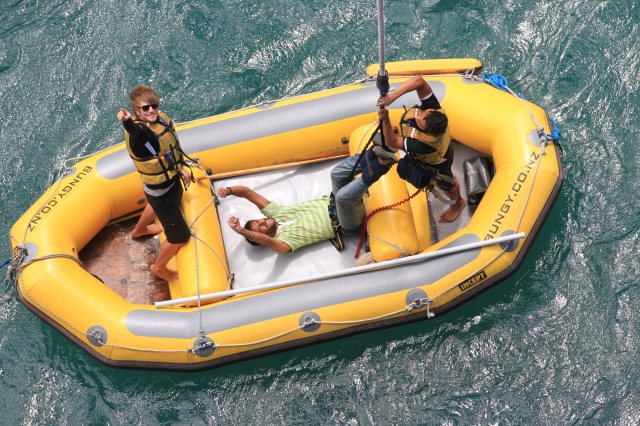
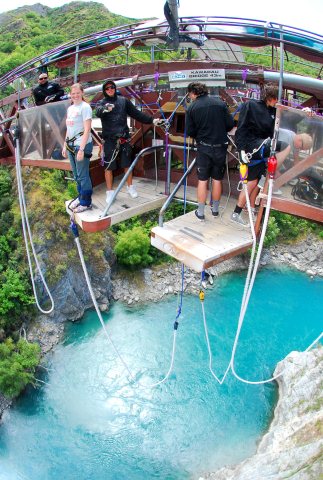
The historic Kawarau bridge, 20 minutes outside Queenstown, is the site of the world’s first bungy jump. Since 1988 people have been jumping off this famous suspension bridge and today, Jill and I had the chance to join them! Much shorter than my last bungy (220 metres in Switzerland), this 43 metre drop gave me a thrill of different kind. Jumping off the platform was just as nerve racking as always. (I hope that potentially jumping to my death will always be at least a slightly scary experience, if it’s not it probably means something’s wrong with me!) But yeah, the fall didn’t last long but the pull back on the first bounce was much more violent than last time. I’m not sure how many G forces I was under but it definitely felt like more than the worst (best?) rollercoaster I’ve been on. After the bouncing stopped I was lowered on to a raft waiting below on the river. I made sure Jill went before me and freaked her out about it as much as I possibly could. I made sure she was adequately terrified of what we were about to do. It might not sound very nice but it was fun (for me!) and I think you enjoy stuff like this more after it’s done if you were scared before you did it. The bungy jump was the last thing we did in Queenstown.

The Routeburn Track

On the morning of the 16th of January we strolled through central Dunedin (so-so) before heading off towards Queenstown and the Routeburn Track, one of my most anticipated New Zealand activities.

Queenstown as a city was very cool. It had a small town feel but with all the shops, restaurants, bars and yes, tourists, of a big city (in a much smaller space). Of course this being New Zealand, Queenstown also had world beating scenery. Stunning mountains could be seen in every direction and they weren’t even that far away. We spent a good while just walking around and exploring as we made the final preparations for our 3 day hike through the mountains and rain forest. 

17/01/2012 – Our bus to the start of the trek took about one and a half hours to get there. On the way we got a brief taste of what we were in for with the trek, there was some amazing scenery around, rolling mountains and lakes as far as the eye could see.

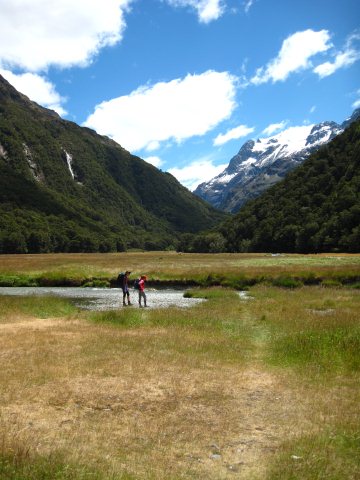
After being dropped off we got settled at the start of the trek before heading off on our 3 day adventure. We were hoping for a slow and easy start but unfortunately that’s not what we got. The difficulty of the hike rose sharply and it tested us fairly early on. There was a good breeze going and the tree cover was comprehensive; we were hiking through thick forests. It wasn’t very hot at all but even so, the fact that we were each carrying a massive, fully loaded back pack slowed us down a fair bit. Undulating mountain paths through thick vegetation, tropical in appearance despite the New Zealand climate, led us to large openings in the mountains where untouched fields, steams and waterfalls were abound. We couldn’t have felt closer to nature in these massive areas between the mountains. We parked ourselves on the grass and had lunch when we reached ‘ground level’ for an especially stunning mountain range. There were waterfalls off in the distance and a large stream passing nearby. It felt like virgin territory, it was so pure that we could just fill our water bottles right from the stream. We didn’t need to treat a single thing we drank. We continued for about an hour and a half after that. The first day was steep but short, maybe only 4 hours of hiking.

Our trek hut was at an altitude of 1,000 metres above sea level. It wasn’t particularly high up on paper but up there, the view was unreal. Maybe a 5 minute walk from the hut, there was a large rock hanging out over the mountain we were on. If you were brave enough to climb out onto it, you could see countless mountains, waterfalls, streams and fields. The mountains were so close, you could see everything. Some of the waterfalls were even closer, in fact two of them were right behind us. I later climbed down to them and got a closer look. I rock hopped through the large pools they were feeding so I could get a front row seat. There must have been a ridiculous volume of water flowing through these things every second, they felt immense when I was standing right next to them.

18/01/2012 – We left the Routeburn Falls hut at 8 in the morning. It was an early start but we wanted to miss the strong winds that had been forecast for later in the afternoon. It ended up working out really well for us. Since we left so early it was a while before everyone else headed out, we barely saw a single person on the trek during the whole day. It was like we had the whole thing to ourselves!

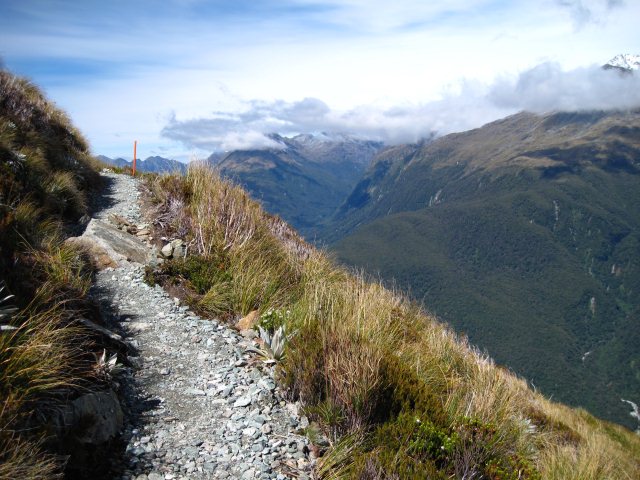
I didn’t really think it to be possible but today was even more impressive than the previous day, it truly was world beating scenery. Up past the waterfall we trekked, on an undulating path with large rocks underfoot. It wasn’t long before the true beauty of the valley we had just passed made itself known to us. Mountains in every direction, lush, green vegetation growing on them, a large, open valley with a river running through it, a cloudless sky, the bright sun. It was stunning. We climbed further. A few minutes of steep track followed by a few minutes of flat track, it continued this way for a while. Right up until a large lake came into view. It had mountains all around it, some of them snowcapped. We continued onward to the Harris Saddle hut. A half-way point of sorts. It was a mental break in the trek, a signal to us that we’d reached a certain point but it signaled something else too. The beginning of probably the most stunning stretch of scenery I’ve ever seen in my life. With soaring alpine views in every direction, mighty snowcapped mountains pierced the clouds and left us speechless. The tree line had been passed and the vegetation was noticeably different, still thick but considerably less varied. Various types of plants, bushes, shrubs, moss and grass kept things interesting though. It wasn’t much longer before that dropped off too. For a short, maybe 15 minute section of the hike, it was mainly long, thick grass on either side of the path. There were other sections though where there was nothing, sheer 1,000 metre drops adorned the sides of the path, with not even a hand rail to prevent you going over. The path changed back about an hour later, there were shrubs and bushes by the path once again but the stunning alpine views remained. We’d gone from walking towards them to walking beside them. We passed a few small streams running down the side of the mountain we were on, taking the opportunity to refill our water bottles. Our mountainside stop for lunch was impressive too. With a view of these huge, snow-capped mountains, stunning lakes, thick vegetation, which rapidly dropped off giving way to huge falls in altitude, we were eating in what was probably the nicest spot I’ll ever have a meal at.

About 4 and a half hours into the hike the tree line was fast approaching. Down below, maybe 1,200 metres down, we could see an absolutely stunning lake, Lake McKenzie. It was our stop for the night. High up from the mountain tops we could just about make out the hut we’d be staying in. The walk downhill was pretty fun, but it was made even more exciting by the forest we passed through on the way to the hut. Filled with 600 year old silver birch trees, it was the most moss-filled forest I’ve been through. And it wasn’t just the one kind either, there were more varieties than I could count and it was on everything. A very unusual (but cool!) sight.

We let everything go when we reached the hut. We were thoroughly exhausted and just spent an hour doing nothing. Eventually we went to sit by the lake, possibly even nicer when you’re right next to it. But one thing it’s not good for is swimming in, the water is bloody freezing! Jill and I went for a short 1 hour hike after that. It ran right along the side of the lake and featured the same type of mossy forest that we’d crossed earlier. It led to a large rock that had been split apart in the ice age. It was pretty cool.

19/01/2012 – The last day of the trek was a speedy descent. The weather didn’t permit many picture taking opportunities so we wasted no time in getting to the end.

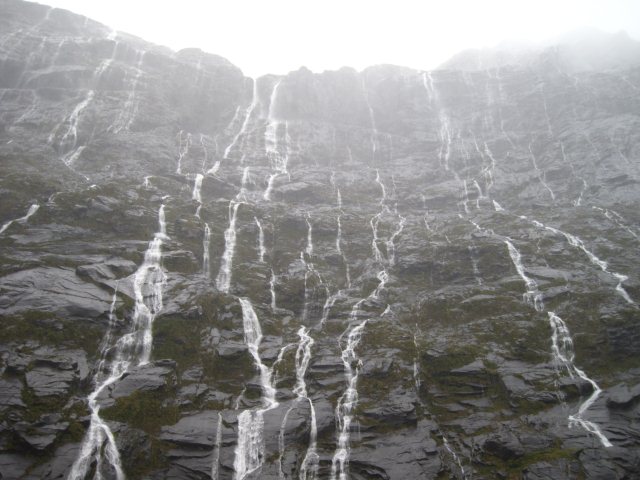
Instead of the glorious sunny weather and near cloudless skies we’d been having for the past two days we had the thick fog and heavy, lingering mist you’d normally associate with green mountainous environments. We had the light drizzle too. As bad as that may sound though it didn’t ruin anything, the most beautiful scenery of the Routeburn Track was seen on the first two days, the third day is basically just a repeat of the first but in reverse. One thing we hadn’t already seen though was the fantastic Earland falls. At 174 metres high it stood very tall as we walked right by it. Yes, the weather may have been bad in most people’s book but the rain actually made things better. It was in quite an unexpected way too. During our bus ride from the end of the Routeburn Track to the ferry port (we’d booked a cruise on Milford Sound when we were arranging the trek a few months ago), we saw waterfalls. A lot of them. These waterfalls wouldn’t have been here were it not for the rain. Where in the past we’d been seeing waterfalls in numbers that barely made it in to the double digits, here we were seeing literally hundreds of them. Hundreds of thin, wispy waterfalls coming down the sheer cliffs of 1,000 metre high mountains. The heavy rain and misty mountain roads lent everything an atmosphere of intrigue and discovery.

The cruise itself was an unexpected treat. Had it been a sunny day, this would have been just another cruise. Admittedly one that passed through stunning scenery, but just another cruise nonetheless. In the rain and gale force winds though, it took on a life of its own. Because of the outdoor clothing Jill and I had rented for the trek I was surprisingly well equipped for this weather so wasted no time in going to the top deck. It was quite a while before anyone else joined me but when they did they really suffered for it. The cruise had maybe 8 people onboard out of 100 that had just finished the Routeburn Track. Those 8 were prepared for the rain to varying degrees (with Jill and I being the most prepared; we were decked out in absolutely everything we possibly could have needed). With everyone else though, forget about it. Some of them had light raincoats, a few of them had those thin plastic ponchos but most were wearing shorts, jeans or skirts. You might think jeans would be ok but this was the sort of rain that soaks you to your very core within minutes. I’m sure I was looking very smug as each person came up, got soaked and then went back down. Good on them for having a go but there’s just no way they were comfortable up there. A few brave souls who were amongst the least prepared of everyone made an impressive show of it though. They were only wearing shorts and thin tops but they stayed up there nearly as long as I did. I completely understood why they did it, what we were seeing up there was worth going the extra mile for.

The number of waterfalls shot up almost instantly. We passed through stunning, world beating fiords and mountains, all playing host to countless waterfalls that together must have numbered well in excess of 1,000. The mist obscured the peaks of some of the mountains making the waterfalls look as though they were coming down from the sky itself. Heavy winds gradually increased in speed and veracity until they reached hurricane force, 70-80mph. They were having a very noticeable effect on the water. Just off the surface but all over it, a light spray swirled like sand on a sand dune. Light droplets of rain, barely big enough to trouble a fly were being accelerated to such a speed that upon impact with your skin, felt like tiny shards of ice. Waterfalls looked as though they were flowing upward and even the bigger, more permanent ones were engulfed in huge swirls of water that threatened to overpower them. It was at once, breathtaking, stunning and a whole body experience. I’ve never seen anything like it and don’t expect to ever again.

About half way through the cruise we passed very close to the largest (by water volume) of the waterfalls. It was only 154 metres high but when we were right next to that raging water it was a force to be reckoned with. During the approach I was lulled into a false sense of security. I could see all the spray being generated but wasn’t feeling any of it. I was going to get through this completely dry! How naive I was! All of a sudden, the wind changed direction, dousing everyone on the top deck with spray and giving me a mouth full of waterfall. All the people that had tentatively ventured up to the top deck for this close encounter probably regretted their decision as soon as that water hit them.

By no means ‘just another cruise’, being on Milford Sound in the rain has to be seen to be believed!

Heartbreak (of the Penguin Variety)

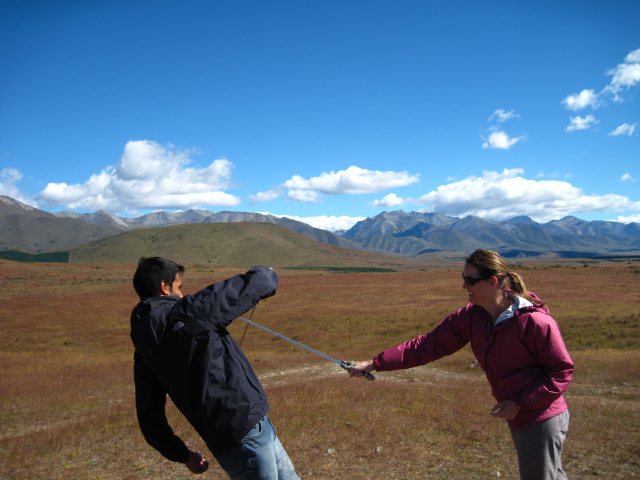
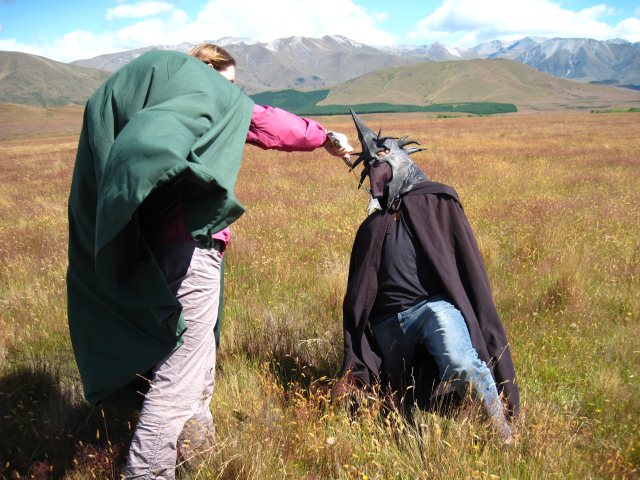
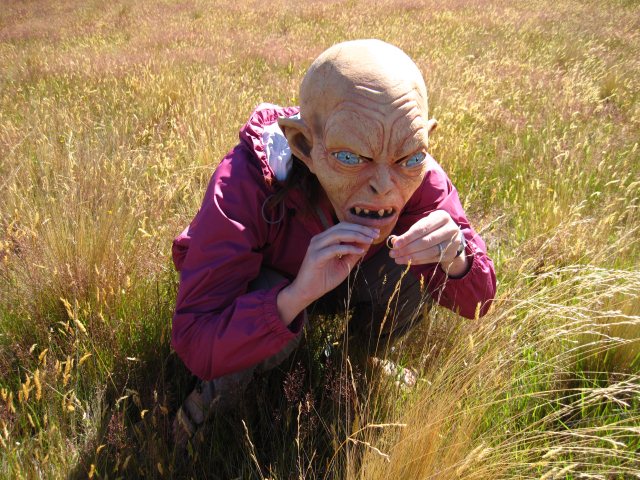
We left Mt. Cook bound for our first Lord of the Rings tour. Twizel was the New Zealand township where most of the Gondor scenes were filmed. All of the major battles in the Return of the King featured Twizel in some way. It was really cool being on the same soil as the cast and crew. Being able to play fight with replica swords and costumes was pretty sweet too. I’m sure we all looked like we were ‘special’ but screw it, I had fun. Our tour guide showed us around the sites for 2 hours, she was full of all sorts of useless film trivia but it was interesting. The main sites she showed us were from and around the final battle in Return of the King but there was stuff from all sorts of other locations too. The fields outside Minas Tirith were very picturesque.

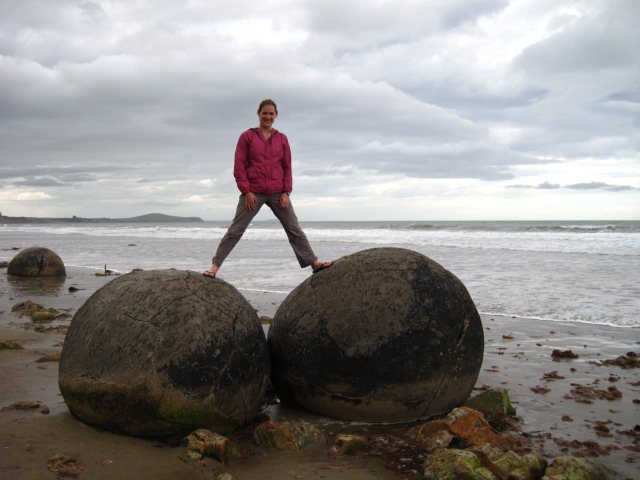
After the tour we continued towards Moeraki for the famous Moeraki boulders. Probably about the strangest thing you’ll find on a beach anywhere, these large, round boulders were certainly an unusual sight. The beach on which they sat was around 8km long but the boulders only inhabit around 100m of it. The car park is a ten minute walk from the boulders so when walking along the beach towards them, we saw a large cluster of people off in the distance, huddled together on an otherwise empty beach. Climbing the boulders and jumping off them was cool.

In what was a busy day, we also found time to go penguin spotting. We drove out along the coast to the Katiki Point Lighthouse but we weren’t very interested in seeing it, the main draw here was the yellow-eyed penguin ‘hide’ at Hide Bay. A steep path quickly led us down to the hide where windows and binoculars overlooked a small penguin nesting beach cove. The penguins go out hunting all day and return at around 6pm (when we were fortunate enough to be in the hide), hop up onto the rocks, dry off and waddle along the short beach to their hidden nests. We saw 5 penguins, 2 of them were fully grown ones that came in from sea and the other 3 were baby penguins waiting for the return of their parents. They were very cute but it was a little heartbreaking seeing them waiting so patiently out in the rain, and then finally, when the adults returned, facing constant rejection each time they waddled up to the wrong penguin looking for food. Those baby penguins didn’t find their parents. They’re probably still out there waiting for them :(

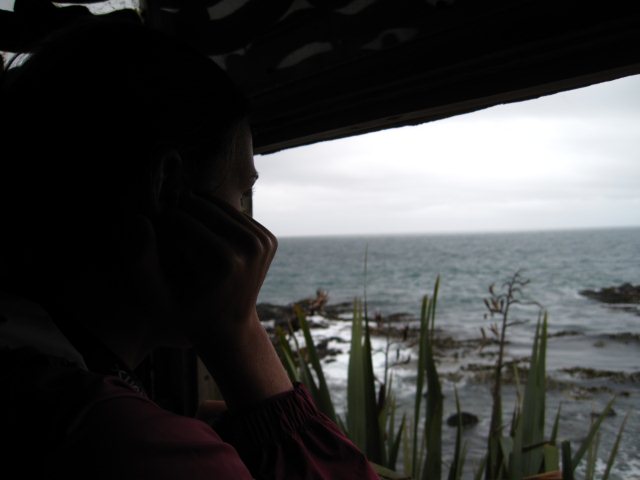
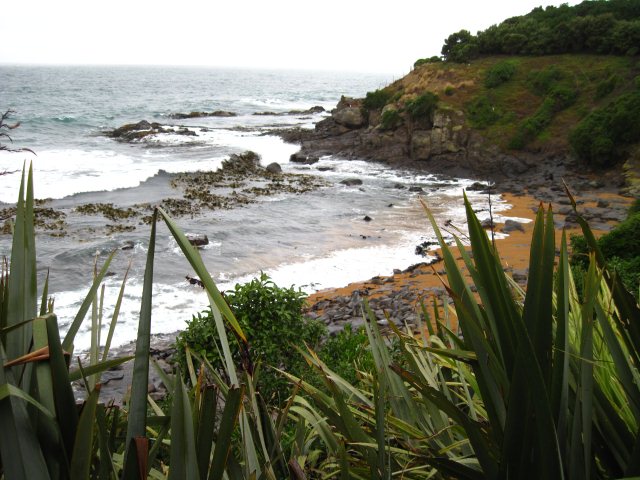
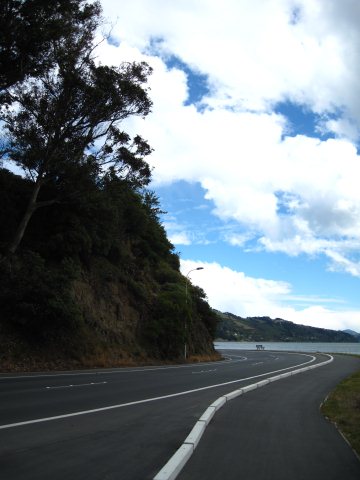
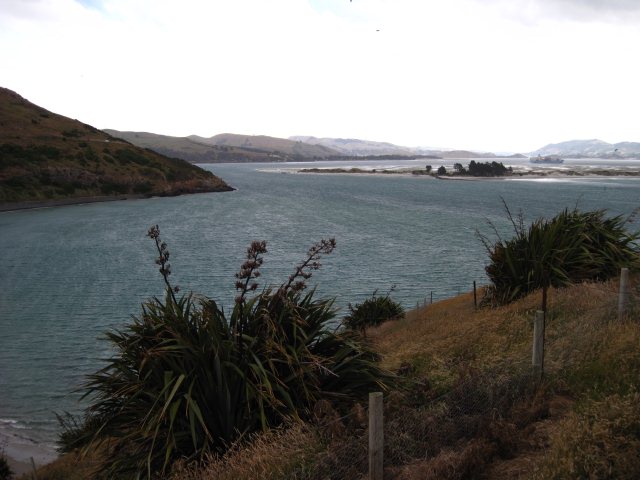
Having gotten a late start the next day (a 1 pm checkout time was a very pleasant surprise!), we arrived in Dunedin at around 2:30pm. We drove through the city a little but today was not the day we’d be seeing it. Today, we checked out the surrounding area and we were very glad we did! We weren’t originally going to come here but Sue was so passionate when she talked about this place that we thought we had to give it a go. True to her word, the area surrounding Dunedin was stunning. Probably as beautiful as the world beating scenery seen when driving into and out of Kaikoura (the most beautiful place in the world, if you missed my previous posts). Driving on these narrow, winding coastal roads was an absolute pleasure. We drove out along the Otago Peninsula, following the road all the way up to a place called Taiaroa Head and its popular albatross conservation centre.

After the drive back on the gorgeous Otago Peninsula we headed to Sandfly Bay. Man, that place was a force of nature!

We went there on a windy day and immediately understood how it got its name. The cliffs at either end of this beach direct the winds inland, allowing them to gain speed and power, shifting huge quantities of sand. There was more sand hitting my face than air!

On a calm day (I got a taste of this when the wind slowed), the contoured and swirly striped dunes were a visual wonderland but it was only with strong winds that this place truly came alive. Everything on the beach (including us) was being blasted by the sand, as I turned away from the wind I saw the swirling sand racing up the myriad dune channels. It looked so cool! Jill hated it, especially walking up the massive sands dunes on the way back but I loved it.

There was a yellow-eyed penguin hide at the far end of the beach. It was a very enjoyable, scenic walk getting there, what with the energy sapping sand dunes and sand blasting wind keeping things interesting (it had started raining by this point too), but the penguin spotting wasn’t so good. There were a few sleeping sea lions around, one of them was right in front of the narrow path leading to the hide so getting around that one was pretty interesting, but we saw more penguins the day before at Katiki Point Lighthouse. An outstanding trip out though!