I do complain about America’s numerous failings often but can’t deny that the country’s natural wonder and in particular its geographic diversity is probably second to none. Jill and I both meticulously researched Boston, the wider state of Massachusetts and even the states neigbouring Massachusetts prior to moving here in 2013 but we were both still caught off guard by the degree of variation in New England’s stunning natural landscapes and the wealth of outdoor activities on offer. The biggest (and most pleasant) surprise was the fact that central New Hampshire, just a two hour drive North from where we’d be living, is host to some of the best ice climbing that can be found anywhere in the world. With my (relatively) new found love of the sport, I was ecstatic.
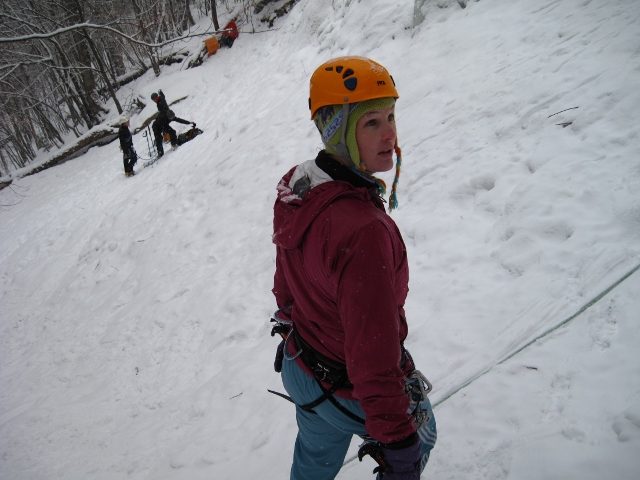
We picked the same mountain guiding company as last time. Synott Mountain Guides served us very well in 2014 (Jill’s puncture wound notwithstanding – refer to last year’s ice climbing entry for details), and there was no reason to think they’d steer us wrong this time. They had moved to a new location since we were last here, one that was much easier to find. In the car park we loaded up on energy for the day by way of the delicious breakfast burritos that our friends from Glenn Oaks had packed for us. When booking the B&B, Jill had mentioned how much I loved the burritos last year so this year, we got two each! (Along with a selection of other goodies). Inside, we met our guide, Nick Aiello and got started picking out our gear. We’d later learn that though Nick is an accomplished climber, having summited Mt. Denali several times, he isn’t quite as skilled as our guide from last year, Paul Cormier. What Nick lacked in climbing experience though (he’s only 25), he more than made up for with personality. After helping load our car full of gear, Nick jumped in with us for the 15 minute drive to Jackson. It looked like there were a few other groups of climbers heading to the same area as us. Nick said on the hike there that it’s called “Texaco” (last year’s was called “Lost in the Woods”). He also told us as we were starting, that the hike would take about 15 minutes. That turned out to be a wholly inaccurate assessment. It actually took over an hour but that wasn’t really Nick’s fault. Snow had been falling for several hours prior to our arrival and coupled with the extreme temperature (it was around -18 degrees Celsius until around midday then warmed up to a balmy -10 for the rest of the day’s climbing), the hiking conditions were not favourable.

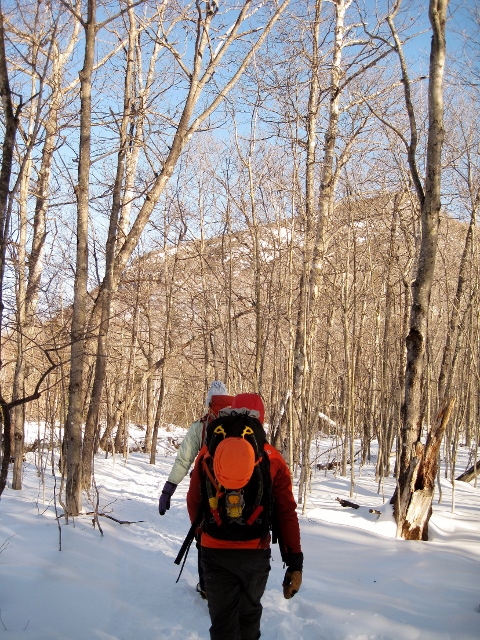

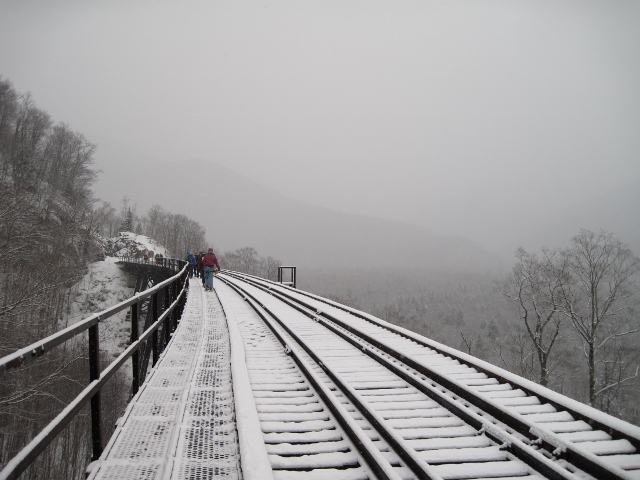
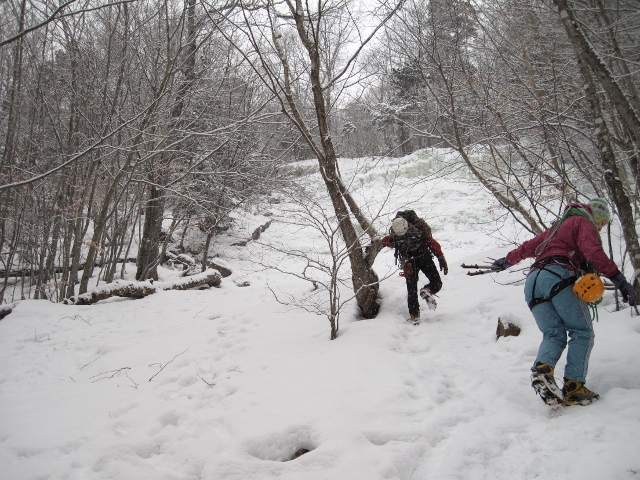
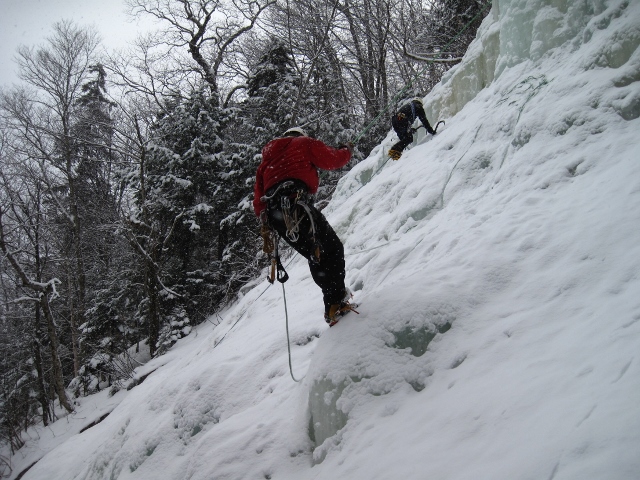
Norwegians are said to have at least 50 different words for snow and after nearly two years of living through the harsh, New England winter it’s easy to see why. Snow can vary greatly in texture, consistency, density, stability and a wide range of other factors. Low temperatures like today’s give rise to light, powdery snow that while ideal for making snowmen, having snowball fights and skiing, does not make for the best hiking, especially when the majority of that hiking is uphill. Many layers of loosely connected snow had accumulated on the mountainside that lay before us and we were already tired from the strenuous exercise of getting to that point. With the snow providing so much resistance to movement, every step was a struggle, a hard fought battle for progress but when the gradient of the hike shifted dramatically, we were facing a losing proposition. Previously, the terrain was largely level with thin, sparsely distributed trees punctuating the serene, snow covered landscape. We had to move through the layers of snow but the frozen streams, ambient sounds of the winter forest and crisp winter air lent the unbroken white expanse of our surroundings a sense of calm, perhaps eerily so. That calm was shattered when we began moving upward. Even when digging each foot into the snow for extra purchase, the ascent was an exercise in frustration. I’d regularly make good progress only for the top layers of snow to come loose and send me back down from where I came. The only relief came from some of the larger, stronger trees that grew on the mountain and acted as breakers to my downward slide. I knew that once I made it to the next tree, it would stop me sliding back down any further than where it stood. Eventually it got to the point where forward movement was yielding diminishing returns. Nick saw this and suggested that we stop to put on our crampons. The game changed entirely from that point on. I forced my first crampon into the snow and felt a stability that I hadn’t known since last year. With each successive placement of my foot I was able to rapidly ascend the steep inclines that had caused such dismay only minutes earlier. There was no longer a need for careful consideration of the environment. Where previously I’d been assessing a multitude of factors before making even small movements and constantly adjusting my route based on changing conditions, now I was able to move with impunity. I was freed from the confines of my environment and able to move up the mountain at a speed I had not considered possible. Jill followed shortly behind.


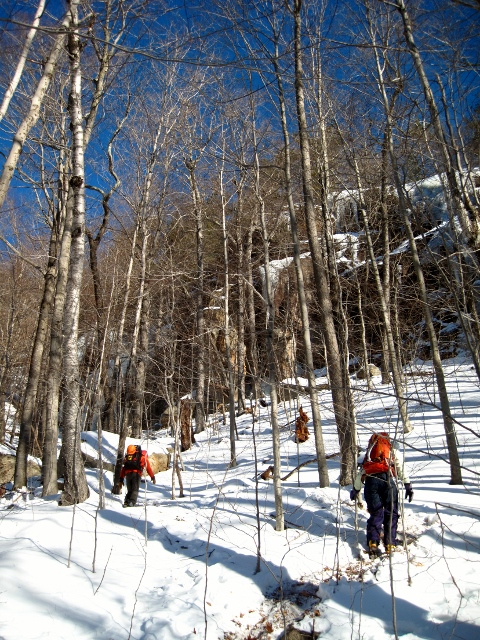
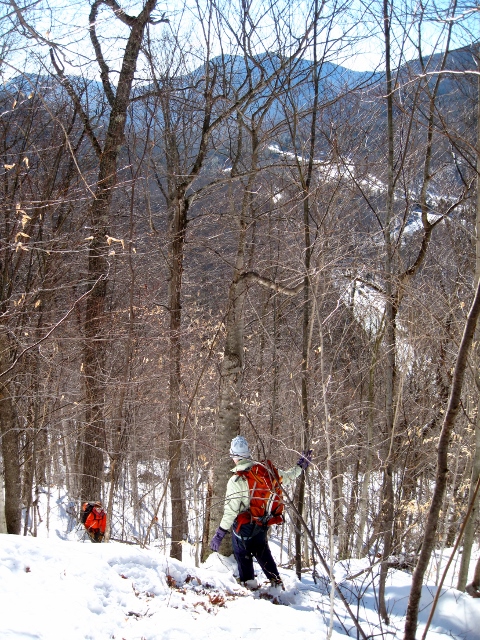
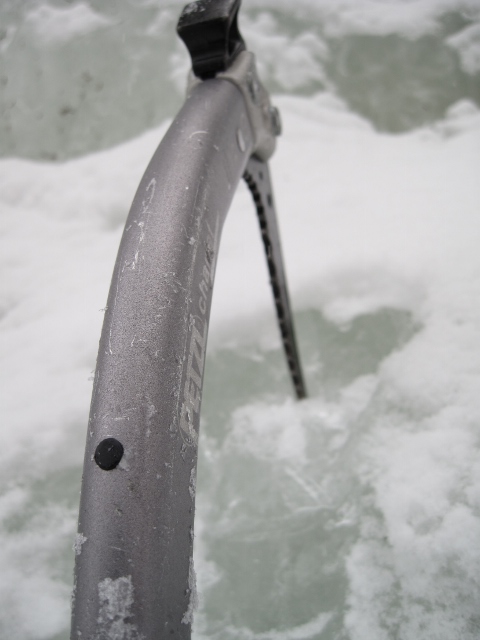
Nick was leading us to a series of ice walls that would present a gentle challenge on which to start the day’s climbing. Unfortunately though, the thick snow at our destination made our arduous hike there redundant. The climb ended on a shallow angled section that was now covered with snow. Nick had been planning to lower us down so that we could climb back up to the shallow part of the ice but with the snow there it was no longer worth it. We hiked back down and around to where the ice walls started. We went knowing that we wouldn’t have to hike back up later. Nick found a spot for us to set down our bags and took the opportunity to remind us of some basic techniques. Throughout the day, he commented that we should keep our heels low when moving up an ice flow, keep our feet level, our ice tools close together and placed roughly head width apart and that when attempting to place an ice tool higher, you should first bring your hips up and press them toward the ice. He also talked about the dangers of ice dams (how ice can trap a high pressure flow of water that would spell disaster if released) and ice mushrooms (when snow builds up over an ice column creating a mushroom that is very unstable). Nick mentioned the strength of various types of climbing rope knots too. It was all useful information that will serve me well in the years to come.
When Nick had finished setting up the rope system for the first climb I stepped up and volunteered to go first. The ice on this first climb had formed evenly and the ascent was at a very manageable angle of around 80 degrees. I remembered my past experience and made short work of it. My crampons went into the 30 metre high wall of ice firmly and shoulder width apart, their lack of movement while in the ice giving me complete confidence in my chosen placements. I kept my heels low when removing each crampon to move higher and surveyed the environment quickly when considering my options for the ice tools. Movement felt effortless and natural and my climbing form was as honed as it had become during the final climb of 2014. I abseiled down once I reached the top. Jill did well on this climb as well though she wasn’t as fast or precise as I was.


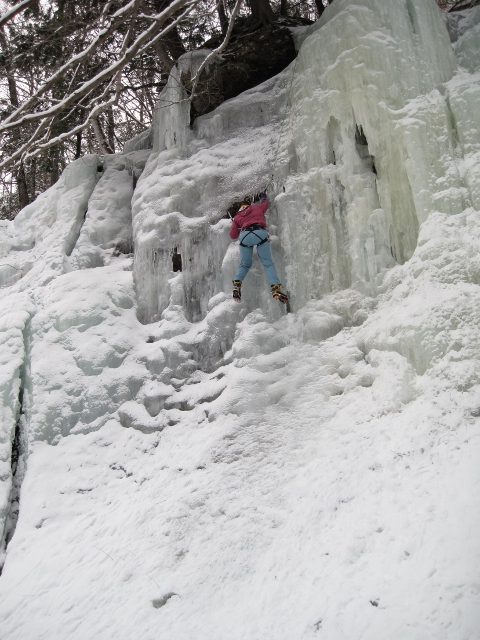
The next climb, to the left of the one we’d just done, was much more interesting. It featured a series of cascades and bulges in the ice that set it up as a three-tiered climb. Each tier was shaped differently than the one before and the angles of the ice changed throughout. There was a large, thin slab of rock protruding vertically from the first section making the choice of an ascent route difficult and to complicate matters further, the types of ice seemed to be different in each of the three cascades. This one would be a challenge. Again, I was the first one up. I tentatively placed my first crampon in the ice to get a feel for it. It was stable but it felt different than on the first wall. I’d have to be more careful here. I proceeded upward remembering Nick’s advice that I should always be able to see my feet when making a push to get over a ledge. I grew increasingly confident with each successive placement and got faster as I ascended. Upward movement of an ice tool was always followed by one crampon and then the other, with me being sure to keep my feet level for added stability. I made it over the first edge with a burst of strength and collected my breath before tackling the next cascade. I lost my footing once or twice but never felt my harness brace to support my weight; I was climbing under my own steam the whole way. I breathed a sigh of relief after the second edge and shortly afterward, had climbed the third as well. The ice walls in each of the three cascades though short, were completely vertical so abseiling down them was fun. I had expected Jill to handle this climb with similar ease but she made a much harder time of it. This was due in part to her left crampon coming loose while she climbed but she impressively managed to secure it at the top of the first cascade. No, Jill’s difficulty was because she forgot to keep an eye on her feet, with her ungraceful attempts at pulling herself up and over the edges of ice being the unfortunate result. She made it in the end but it could have been much easier.


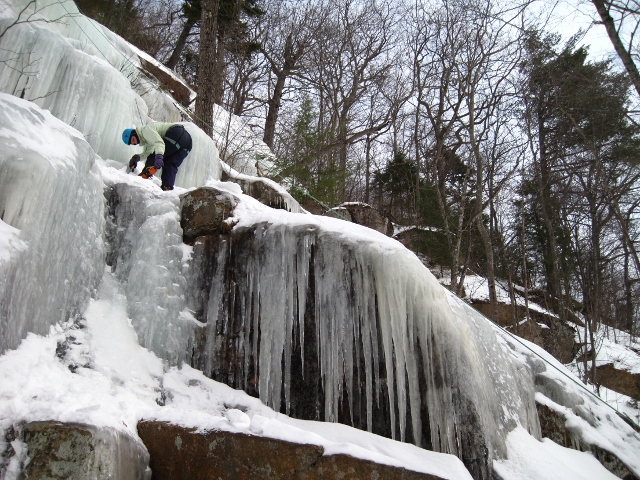

At the bottom of the second climb, my fingertips felt very cold just as they had at the bottom of the first. This time was worse though. Placing the ice tools firmly during each ascent meant holding my arms far above my head for sustained periods, impeding blood flow. My fingertips had become SO cold that the sensation of returning warmth was painful. I’d only experienced this feeling once before in my entire life; at Niagara Falls with Jill in 2011. Nick encouraged me to “windmill” my arms to speed up the recovery but it wasn’t good. Coupled with my dehydration (the water in the exposed drinking tube of my water bladder had frozen making the entire bladder useless), the sharp pain in my hands made me feel as though I needed to throw up. I wasn’t going to let the cold beat me. I summoned a resolve that had lay dormant for years, waiting deep within for a time at which it would be needed. The time was now. I rode the wave of gradually subsiding discomfort as the warmth returned to my fingers. When it was over I walked over to Nick and asked if I could drink some of his water. Thankfully, my water bladder itself had not frozen so Jill was able to top up Nick’s supply when we’d both had a drink. The pain of returning warmth had also affected Jill but with her it struck in the feet. Our problems with the cold and Jill’s difficulty with the second climb had left us both demoralised. We weren’t excited at the prospect of further climbing but had a bit of time before we’d need to do it again. The break helped.

After Nick had taken down our ropes we walked back in the direction that we’d come from. The area was busy, Nick left Jill and me alone so that he could scout out some available ice flows. The area in which we waited was much more visually striking than the one we’d just left. Dramatic blue-white ice flows came down over the edges of the cliffs and formed monolithic structures that stood in stark contrast to the underlying rock. There were almost ten of them in all, getting gradually shorter from left to right. Jill and I watched the climbers’ attempts as we waited, slowing building our appetites to get back out onto the ice. When Nick came back we were ready to go. We walked past all of the ice flows and around a corner to the left. We were met with yet more flows, equally dramatic as the ones we’d just seen but fewer in number. These got shorter from left to right as well. Nick set up our ropes on the rightmost pair of flows. Each of them was less than 10 metres in length but featured by far the most technical climbing either Jill or I would attempt today. Nick commented that our two ice flows included the most difficult climbing of any of the flows, regardless of length. On the way there, we ran in to Paul, our guide from last year. I would say it’s a small world but I guess it’s not that unusual for us to have run into him here. He was climbing on the flow immediately to the left of ours and watching him climb, I was reminded immediately of his astounding ability. It was nice catching up with him briefly and seeing him in his element.


Back at our ice flows, despite me being eager to get back to climbing, my previous activities had left me tired. I attempted an ascent of the bigger of the two flows but realised early on that it wouldn’t end well. I moved over to the second flow and started up. The ice was very awkward to climb. Its contours and textures changed from one section to the next making a consistent approach impossible. I constantly had to adjust my tactics and revaluate my position in light of the changing climbing environment. At one point I slipped entirely, losing my footing before I had a chance to firmly affix either one of my ice tools in the wall. I swung around to the right almost going all the way around to the back of the flow. On the way, I knocked several icicles off an overhang in the cliff, sending them spiralling downward. They shattered like glass on the hard rock below. I hung there for a moment as the harness supported my weight, and dropped my arms, letting them dangle. I needed to regain some blood flow and hopefully, some strength. After a moment, I readied myself for a second attempt and this time, with a more measured approach, succeeded. I breathed a deep sigh of relief. A feeling bordering euphoria overcame me as I stood at the top of that cold, icy cliff. Jill made the climb straight after I did and was more impressive with her ascent. She slipped off at one point too losing about 6 feet in the process but didn’t swing around to the side like I did. Overall, she was a bit quicker in climbing the third ice flow. We started gathering our gear and got ourselves ready to leave. The sky was darkening and the hike back went quickly. I talked with Nick about all manner of things as we walked: interesting films from 2014, modern figures that will be remembered fondly by history, the future of space travel, climbing Mt. Denali. All sorts of things. The sun set during the drive back to the Synott Mountain Guides building and it was nearly pitch-black after Jill and I said our goodbyes to Nick.

We were hungry after getting back but both knew we wouldn’t leave the B&B if we returned now. One of the things Nick had mentioned during the day was which restaurants in the area are good. We picked one of them (Delaney’s) and headed straight there. It was busy; there was a wait of over an hour for a table but pretty soon after we arrived two seats opened up at the bar. We decided to skip the wait and just eat at the bar. We each had a burger and split an order of fried chicken as an appetizer. The food wasn’t bad but it wouldn’t be winning any awards.
After getting back to the B&B, I was able to take my shoes and socks off and have a look at my right toe. It was causing me discomfort earlier but I wasn’t sure why. The nail on my big toe did not look good at all. Jill thought it was ready to fall off, I thought it would heal as it’s done in the past. Regardless of what would happen in the coming weeks though, I knew I was in pain now.
We went to sleep pretty early after watching some TV.




 STOP BY FOR POT PIE