It’s been a long time coming but this January, I was finally been able to return to one of the best things I’ve ever done. My top five activities of all time (as they currently stand) are as follows:
- Black water rafting/caving, NZ
- Ice climbing at Fox Glacier, NZ
- Hiking the Routeburn Track, NZ
- Scuba diving the Great Barrier Reef, Australia
- White water rafting on the Zambezi River, Zambia and Zimbabwe
You can imagine my delight when I learned that New England has some of the best ice climbing in the world. Being the loving wife that she is, even though she didn’t enjoy the experience of climbing as much as I did, Jill found us some options for where to go and which guides to go with. She didn’t waste any time in making a booking either.
On the day of the climb, we headed out early to avoid the crowds. The proprietors of our B&B (Glen Oak Inn, which was lovely, by the way), made us some delicious breakfast burritos to take with us since we told them we’d be leaving before breakfast time. They packed us some other goodies too so we needn’t have prepared a lunch for ourselves as we had more than enough energy to get us through the day.
The guide company I picked was Synnott Mountain Guides (I loved them so will definitely use them again. The owner, Mark Synnott is a pretty big deal too apparently, as far as climbers go). When we got there, Mark introduced us to our guide Paul and we started picking out boots and equipment. Since it was just going to be Paul, Jill and I for the day, Paul left his car behind and threw his stuff in with ours. Jill drove the 20 or so minutes to where we needed to go. The roads still had a thick layer of snow on them.
It was promising that there were hardly any cars parked at our destination and true enough, we barely saw anyone while we were out there. It was about a 25 minute hike to the cliffs and frozen waterfalls we would be climbing. We started on our way.
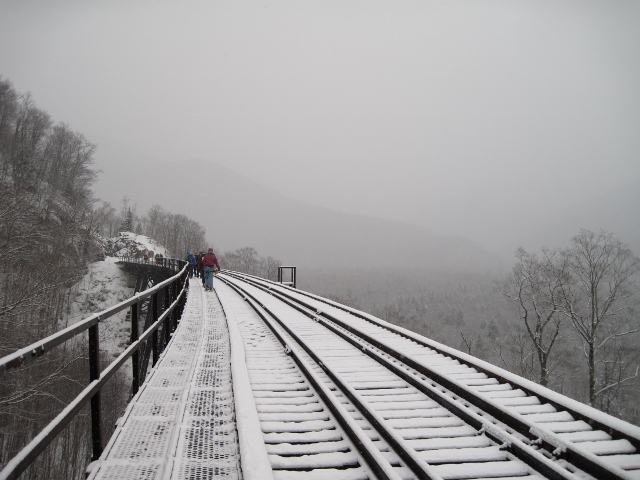
Even with our boots on, walking in the snow was not easy, it took considerably more energy than it normally would have given the distance we covered. For that spent energy though, we were rewarded with stunning winter scenery. Thick snow covered the ground, trees and mountains as far as we could see. We spotted frozen waterfalls far off in the distance and also on the cliffs to our left, eventually, we reached a bridge on a support structure about 60 meters off the ground. Upon seeing what I realised was a disused railway bridge, it slowly dawned on me that we had been walking on a railway line this whole time. We had to cross the bridge to get to where we were going. It was more than a little disconcerting walking over it as it didn’t seem to be in the best shape, it was also pretty slippery and there were large gaps between the rails that a person could easily have fallen through. Still though, the view was incredible. The cliffs were to our left but as I looked to the right, I saw a vast expanse of snow covered mountains and forest. The snow was still falling too. Each snowflake was small and light, forming waves of fine, ever changing curtains of precipitation that stretched way out to the horizon. The sheer volume of it leaving the clouds made the sky and the air below it look as though they were consumed by a non-existent fog.


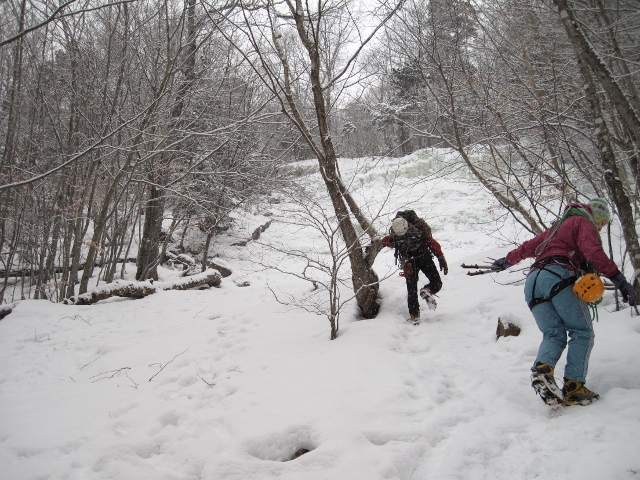
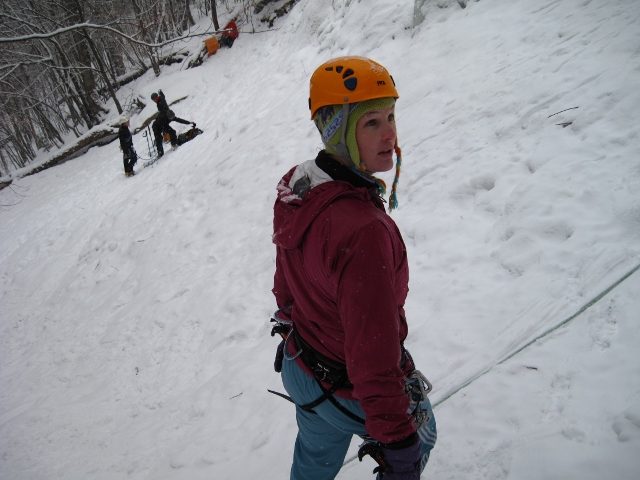
On the other side, after crossing the bridge we hiked for another 10 minutes before turning left, into the forest that would lead us up to our cliffs. It was very steep. So much so that we put on our crampons before we entered the trees. We went uphill for another 10 minutes or so before we were finally able to start getting set up. We’d reached a snow covered clearing in the woods and were faced with several small ice covered cliffs and frozen waterfalls. Paul talked us through the different kinds of ice we were seeing; the old, brittle, yellow ice that stood where a wide waterfall once flowed, the blue, solid ice we should look for when trying to find good spots to climb and various shades in between. I learned a lot today and not just about technique and what I’m capable of but also the equipment we’d be using, what it can hold and how it works. It was very interesting and indeed, was information that will serve me well for years to come.

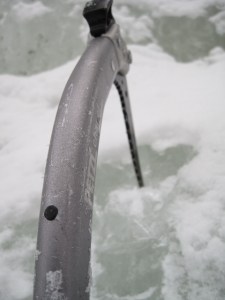


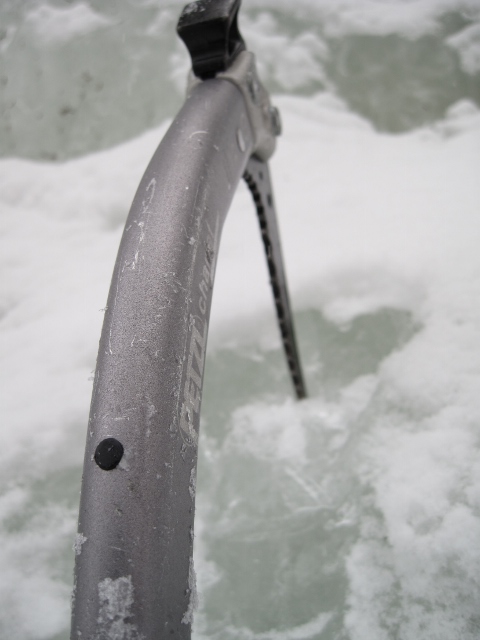
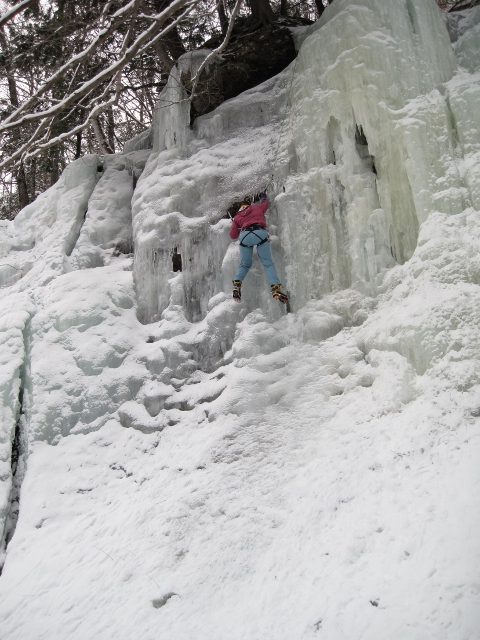
When we were about ready to start, Paul headed up one of the ice walls to set up the support system and lower the belay rope. I was first up. It had been two years since I last did this but as soon as I started it felt very natural, the crampons were going into the ice, the ice tools (axes) were making good contact and I scaled the 20 meter wall in no time. I shouldn’t have been so cocky though because after Jill was done (she scaled it with similar ease), Paul told us that our technique was off. We were raising our feet too high, making it much more likely that the crampons would come loose from the ice, our tools were going into the ice too far apart and we were relying too much on our arms and not enough on our legs. He was nice about it but I took all that to mean it was a bit of a disaster.
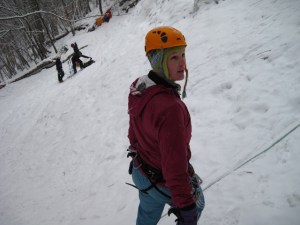

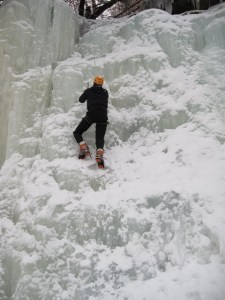
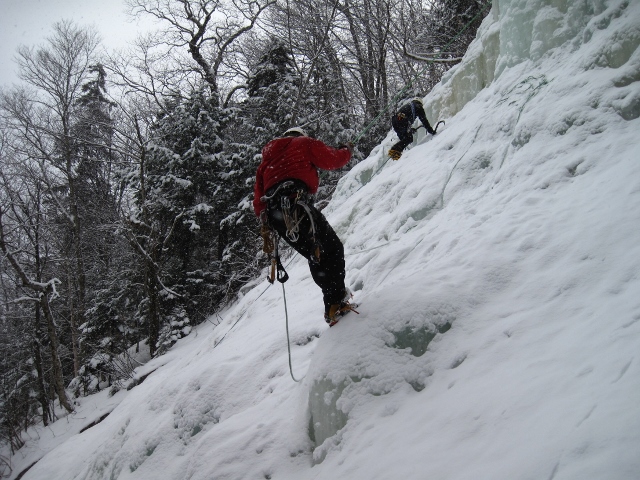
The next cliff we climbed (everything we went up during the day was pretty close together), would be crampons only. We needed to work on our technique. When Paul was demonstrating, he went up the intimidating, near vertical wall of ice like it was nothing. I wasn’t feeling confident about attempting this but my fears proved entirely unfounded. I upped my game and was working on a different level when I ascended. I was more cautious with my placement and actively scanned the ice before making each move. My crampons didn’t slip once and when I was back down on the ground, had new found confidence in my abilities. The third cliff was much tougher. Changing types of ice, overhangs and generally uneven surfaces made climbing it difficult. I made it to the top but slipped twice on the way up. Were it not for the rope (and Jill belaying me), I would have taken a very nasty drop.
The fourth climb was the monster. It was what everything else during the day had been building towards. A 20 metre frozen waterfall, it was completely vertical with some serious overhangs and a very uneven climbing surface. Even worse the ice was yellow, meaning it could be brittle and that at the very least, small chunks would probably break off while I was climbing. This thing looked scary. Again, I was first up. By this point we’d all had some snacks so I had the energy but knew it would be tough. My crampons and ice tools went in the ice ok but it was tough judging where to place them. I was tiring myself out by reaching too far above with my left arm and constantly resorting to pulling myself up rather than using my legs. I slowly ascended but it was very tiring. I slipped off the ice completely on 3 occasions and needed to rest for a bit too. The rope saved me just like last time. Climbing a tough section about halfway up was so energy sapping and demoralising that for a second, I considered giving up and going back down. That just wouldn’t do. I mustered my strength and made another charge towards the top. I had to be methodical lest I tire myself out again but in the end, my patience paid off. I made it to the top and was rewarded with a stunning view of the surrounding mountains. The feeling of elation upon setting foot at the top was immense.

Jill, having done as well as me or even better on the previous climbs really struggled with this one. She fell as many times as I did but after getting back into the ice, just didn’t have the stamina to make it up. Paul and I urged her on. She adjusted her strategy and moved to the left of the waterfall, there she was able to ascend on a section of frozen rock rather than the waterfall itself making for a more straightforward climb. Near the top, she moved back to the waterfall and climbed over, onto the top. Even from the bottom, I could see the relief on her face.
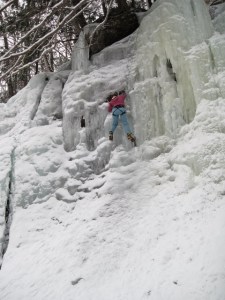
She stayed there a while as Paul adjusted the rope system and climbed up too (he took a much less arduous route, on the third ice wall we climbed). The reason he went up is that earlier in the day, he said he would take a picture of Jill and I together at the top of a tough climb and then the three of us could rappel down together.
I still needed to get up there though. After Paul adjusted the system one more time, I had my route set. My fifth climb of the day would be the third ice covered cliff that I had found so difficult only a few hours earlier. Now though, I was a changed man. I’d conquered an ice covered waterfall with my crampons and ice tools and lived to tell the tale. Armed with everything I now knew, my ascent was a sight to behold. My feet went into the ice flat and stayed shoulder width apart, my heels were low as the crampons left the ice, my ice tools stayed head width apart and made perfect contact with the ice wall each time, step by step, the skills I’d learned and honed during the day were being manifest by my body and put into glorious motion. It felt fucking amazing.
At the top, I took a moment to contain whatever it was that I’d experienced while climbing that wall. When I turned to face Paul and Jill I noticed that he’d set up one last rope system, securing them both to a tree. After I was hooked in too we were able to get our pictures taken. When we were done, Paul rappelled down so he could take another picture from the bottom. I was next and Jill came down last.
That was that. We packed up and started on the hike back. It’s pretty great living in a place where I can look forward to days like this every year.

























 STOP BY FOR POT PIE