Covering our whole last week in New Zealand is a bit of a challenge in one post, but I wanted to wrap up our journey at the same time as we are leaving. This is another joint post, although mostly written by Jaz, the beginning and ending is written by Jill.
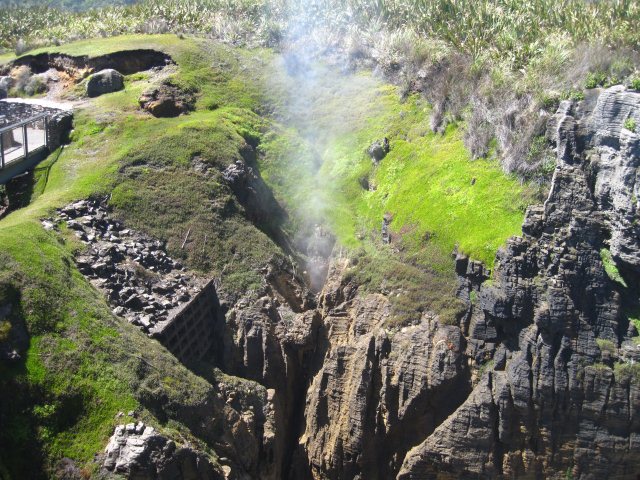
Leaving the glaciers, we had an uncharacteristically busy day, stopping in Punakaiki, with its pancake rocks and blowhole, on our way up the West Coast. The history and story of the geological formation of these rocks is very long and interesting but I don’t feel like boring you (for once), I’ll just leave it at: they’re really big, there are loads of them, they look cool and their pancake like layers continue to defy scientific explanation. The blowhole bit comes into it because at high tide, these massive rock structures channel and amplify the waves coming in from the sea, resulting in impressively violent displays of water displacement. It looks (and sounds) badass. We walked around this scenic coastal area for about an hour, making sure to take in all of the cliffs and different types of blowholes. I’d seen some of this type of thing in Australia so it wasn’t completely new but never had it been as impressive it was here.
Driving a little out of our way, we stopped in Ngakawau, a nice little town that plays host to the Charming Creek Walkway, one of New Zealand’s most un-touristed scenic walks. The Charming Creek Walkway was (sorry, can’t help myself), charming. The word that perfectly describes it is in the name of the walk itself. The path takes about 2 hours to complete and runs along a disused railway line. Nature has been allowed to take it back and rivers, forests, caves, cliffs and waterfalls (one of them impressively large) can all be seen or passed through on the trek. There are a few suspension bridges that form the route too, it’s all so quaint and… Charming. The sign posted route ends (but the train tracks continue) at an old mill. The mill has long since ceased all operations but various parts of it, all heavily rusted, can be seen by a shelter built in its place. Signs within document the history of the mill and what was produced there. It was a pleasant little diversion but it won’t be topping any lists of New Zealand’s best activities.

After a couple more stops on the West Coast, we made our second ferry crossing, leaving the South Island behind to say hello to the North Island again.
Taupo – A day in which we did only one activity but it was certainly a day to remember. This was the day. The day Jill and I had decided we would jump out of an airplane! I’m not sure how to begin explaining it because jumping out of an airplane is a singular experience. Nothing I’ve ever done has been like it and I already know that nothing I do in the future will compare to it.
Anticipation of what we were about to do began building without warning. I was completely fine during our briefing on the ground and through all of our preparations. It was even ok when I first got sight of the plane that would be taking us up but from almost the second I got in, the realisation dawned on me. This was for real. Jill and I were getting into a plane that there was only one way out of and it was a LONG way down. 15,000 feet was almost too high up to comprehend but it but became unpleasantly clear when we were about to jump out. We saw during the painful (for me at least, Jill was completely fine right up until she jumped) 20 minute flight up that the scenery was stunning but during those first few seconds it was impossible to appreciate it. The altitude required we be given oxygen on the way up but it did nothing to quell my nervousness.
Jill had the misfortune of being last on to the plane, which meant she was first out. I could tell she wasn’t ready. There was a camera in the corner of the plane to would take our exit photos but she completely missed it and her tandem master had to put his hand on her head to turn it towards the camera. A second later and she was gone. I didn’t even have a chance to consider what had just happened before I was being hurried to the exit. Jill had just been thrown out of a plane with a parachute that may or may not have worked. She was gone in the blink of an eye. I was sitting in the plane’s doorway with my legs dangling out. My picture had just been taken and my tandem master was strapped to my back. Before I had a chance to say or think anything, my world was turned upside down. The sudden torrent of incoming sensory data tested my brain as it struggled to make sense of what was happening. It processed what my eyes were seeing, what my ears were hearing, what my body was feeling but it took a few seconds for me to catch up. After the feeling of being a raindrop in a hurricane had passed I could truly understand what I was experiencing. The place we had chosen to jump, Taupo, New Zealand, is host to the largest lake in the southern hemisphere. As with almost everything in this country, a mountain range seems to have been included as standard. From the ground it was stunning but from the air, it took on a new found beauty. I could appreciate it from here in a way that I never could have before. The air rushed past at a deafening pace, the ground getting ever closer as I approached terminal velocity, the fastest speed at which it is possible for a human being to travel unassisted by some form of propulsion. There was a massive force bearing on my body, I had to struggle to keep my arms down against the deluge of air I passed through.
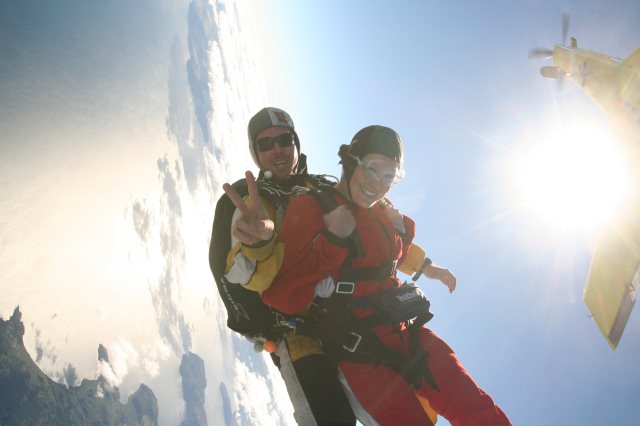
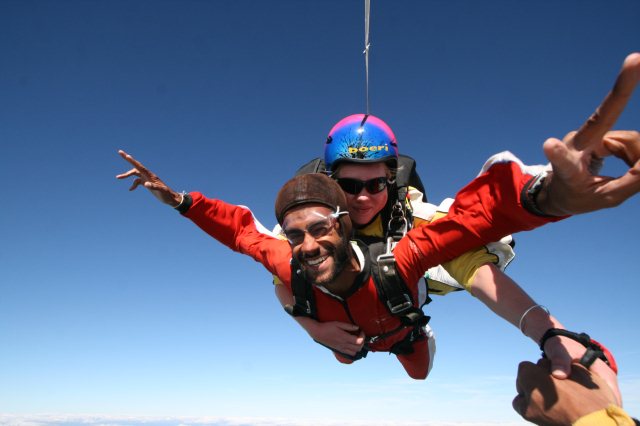
After 70 seconds of it, 70 seconds of hurtling towards the earth at no less than 200km/h, my tandem master pulled the cord. It was a sudden deceleration but nowhere near as bad as I had imagined. It became a completely different experience after that. Sort of like parasailing but better because we could go where ever we wanted. Turning the parachute to adjust trajectory, looking so sedate on the ground felt entirely different in the air. It felt more akin to a rollercoaster. I was more aware of my internal organs during these maneuvers than at any other time during the skydive. The scenery really was amazing though. Lake Taupo was an incredible sight from the air and I had several minutes to appreciate it before we had to turn back towards the landing zone. We came in fairly hot but in the end it was a very calm touchdown. One thing well and truly checked off the list, and it was a day I wouldn’t soon forget.
After that, it was on to Rotorua. Rotorua is unique in New Zealand and relatively unique in the world. Unless you plan on going to Yellowstone, Iceland or Kamchatka Russia, Rotorua is the most active geothermal area you’ll ever see. This place has a lot to offer: steaming cliffs, boiling mud, powerful geysers, hot rivers, coloured terraces, rainbow-hued pools, lakes, hot pools, redwood forests and more. The only problem is that none of this stuff is a secret. Rotorua is also known by the name RotoVegas and for good reason. The number of tourists here was ridiculous but we managed to avoid the hordes when we visited our two stops here.
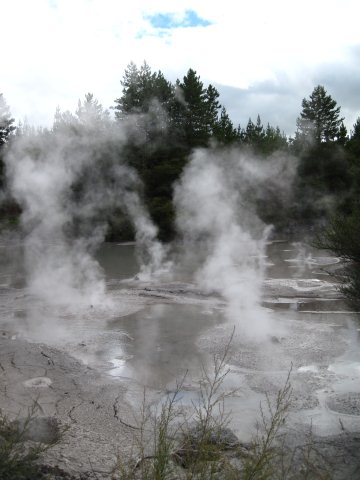
The mud pools, how to describe them? Hot gas rises up from deep in the earth travelling through miles and miles of rock. The gases bring noxious fumes with them (you smell Rotorua long before you get there) and at the end of their journey, bubble up through the mud, sometimes in impressively violent displays. They collect and swirl in the air. There’s a primordial quality to it, it feels ancient. Hot, boiling mud below, with clouds of swirling gasses rising from it. The smell of sulphur was in the air. It felt as though I was looking at Earth millions of years in its past. The area was very cool, I’d never seen anything like it before.
When that was done we hit the road once more. This time we drove for an hour before reaching our destination but made a short stop on the way. It wasn’t much more than a diversion (since we didn’t swim there) but Kerosene Creek, a natural hot water spring ad waterfall, was pretty cool. At the very least I can say I’ve seen a hot water spring now. After that it was on to our second Lord of the Rings tour! The Gondor stuff in Twizel was cool but both Jill and I knew going into this one that it would be better. The woman running our tour last time had to constantly show us clips from the films to contextualise things but here it was not necessary. The untouched film sets were all still here. This WAS the shire! The hobbit holes, the tree swings, see-saws, the party tree, the lake, the pub, everything was here! It was an interesting experience walking around, seeing things from probably my favourite trilogy but even better, things that would be used in an as yet unreleased film. We knew it was the real deal when at the start of the tour, before we even did anything, we were asked to sign non disclosure agreements saying we wouldn’t discuss any of the sets or post pictures or video of them online. It was serious stuff.
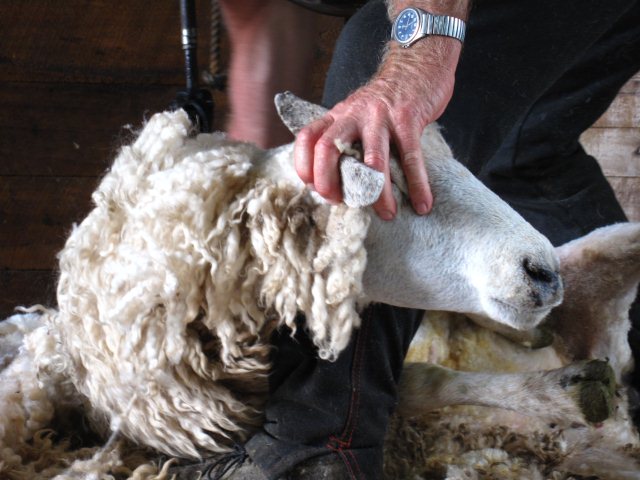
Another cool thing was that this whole area was still a working sheep farm. There were loads of sheep and cute little lambs everywhere. And at the end of the tour, we had a live sheep shearing demonstration (it sounds lame but it’s interesting if you’ve never seen it before). They let us bottle feed the lambs too (Jill was considerably more excited than me about this part – but they were cute :)). With the Lord of the Rings tours well and truly done all that’s left for me to do now is re-watch the films!
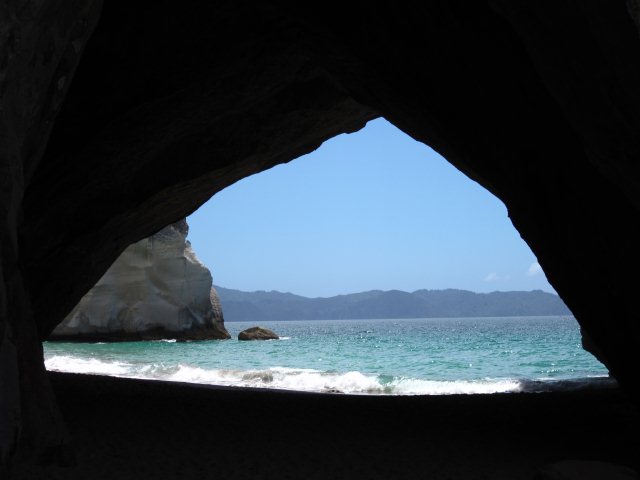
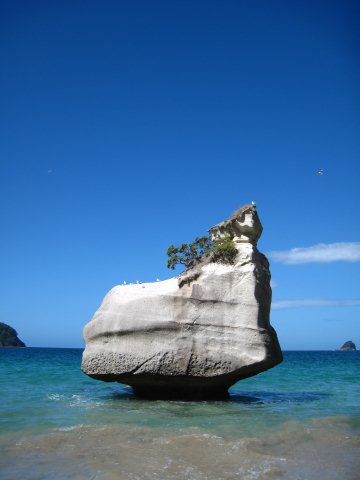
Our last day of major sightseeing, we went to Cathedral Cove, unquestionably New Zealand’s finest beach. Unquestionably! It packs so much into to such a small area that it’s hard not to be taken with it. It was a 45 minute walk in really hot weather to get there though so you really had to want it (the walk featured fantastic New Zeland coastal views, mind you, but you still had to want it). When we did finally get there, all hot and sweaty from the walk, we were instantly taken aback by how beautiful it was. The star of the show was the cathedral shaped cove but there were all sorts on display; really cool sea caves, a dripping waterfall, massive rocks (like Australia’s 12 apostles) but they were only a few feet from the sand so you could really appreciate them, there were even smaller rocks in the sea that you could swim out to and dive from. It was incredibly beautiful and were it not for that amazing beach in the Whitsundays (not Whitehaven but the other, unnamed one), this would surely be the nicest beach I’d ever seen.
But we weren’t done yet! After we left Cathedral Cove we went to another world beating beach, this time one that regularly appears on top ten lists of the world’s best beaches. The reason this beach appears on those lists isn’t for its beauty (though it has that too), no, this beach has a unique quality that sets it apart from every other beach on Earth. Directly beneath it, beneath the sand, there are geothermal vents that feed underground hot springs. If you come here at the right time (two hours either side of low tide) you can dig into the sand and create your own private hot pool! How cool is that? Well, I say private but there were actually hoards of people here (a place this special couldn’t have been secret for very long) but I still dug my own hot pool on a beach! Seriously, how cool is that?
There were times where my patience was tested though; we only had one shovel and digging a hole both large and deep enough for Jill and I was not easy or a quick thing to do. It was painstakingly slow and after I’d got over the initial problem of having sea water constantly flowing into my hole (something that was overcome when the sand wall around it got high enough), I had another problem when pieces of the sand wall started crumbling and being deposited into the hole they’d just come from. Their construction was sound but the water movement in the hole was continually eroding the base of the wall. It was tough. This made it all the more heartbreaking when after half an hour of digging, I had to abandon my hole and admit defeat. You see, there are only two hot springs under the beach and though I knew roughly where to dig I’d picked a bad spot to start. I stubbornly continued even after I knew I probably wouldn’t find any hot water here but in the end I had to give up. But we couldn’t come all this way and not even feel the hot water! What we ended up doing (thanks to Jill’s great idea) was extending someone else’s hole where the water had already been found. Despite my initial embarrassment at doing this, it was completely worth it. It was a very strange feeling sitting in a hole at a beach whilst bathing in near boiling water. There was cold water coming into the pool to cool it down a bit but parts of the now massive hole (a lot of other people had the same idea as us) were no-go zones because they were just too hot. It was all pretty great though. We stayed in there for maybe 10 minutes before giving someone else a go.

After leaving the Coromandel Peninsula, we headed back to Auckland to return our camper van Dinky (Jill continued to call it that despite my protests so I might as well mention it here at least once). We had a chance to explore the city, much nicer than last time since Jill wasn’t sick like she was the first time in Auckland, and get last minute shopping done before having to head to the airport early in the morning and bring our trip to an end.
I know we’ve pushed out our New Zealand blog posts rapid fire, so my apologies for not keeping everyone as up to date as we were able to in Australia. As I wait in Sydney (shockingly, my fourth time here on this trip) for my flight back to the United States, it seems like I just left home. When we first started planning the trip, it still seemed like a bit of a dream, something that would be amazing, but not really happen. It seemed like we had so much time when we first got to Australia, and through all our discoveries and adventures there, we always knew that we’d have a whole month in New Zealand afterwards to continue our journey. This last week or two in New Zealand has passed in the blink of an eye, and seemed to speed up as we got closer to leaving. In spite of that, we still saw many gorgeous sights in our last week and made many more memories to take home. At 100 km short of 5000, we certainly covered a lot of ground in New Zealand, and though I’m sure we missed a lot, I think we saw a good representation of the country. I hope that you all have enjoyed following our amazing journey as much as we’ve enjoyed sharing it with you.
 STOP BY FOR POT PIE