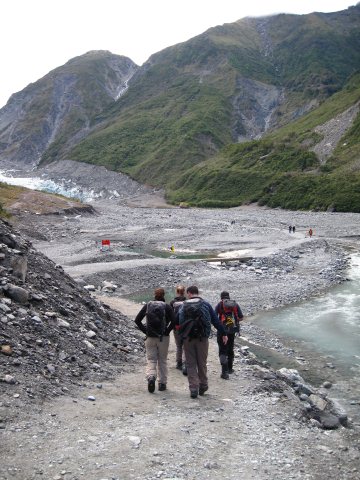
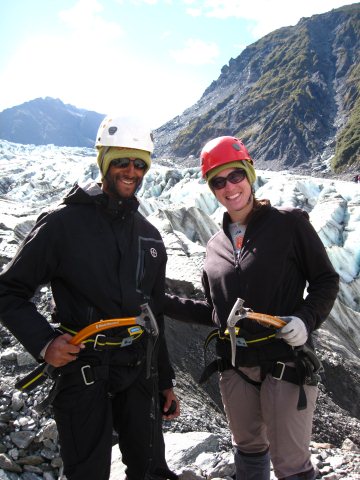
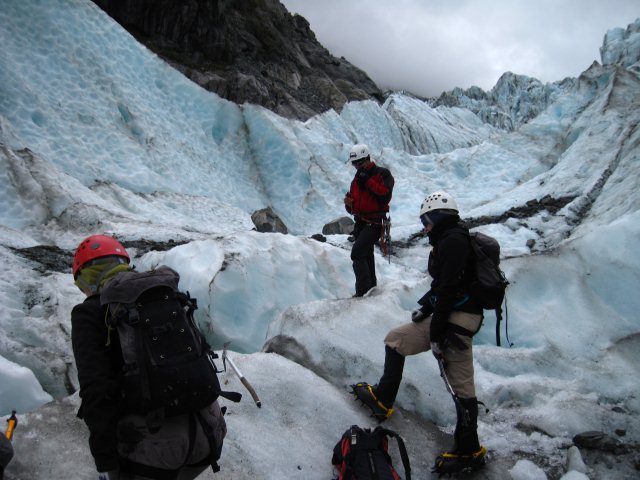
Ice climbing! We met with our Fox Glacier guide at 8am. After gathering our equipment it was a short bus ride to the glacier before we set off on foot. The hike up was probably the toughest part of the day. It was a long slog getting up to the glacier. Some parts of it were so steep that the only way up was literally one foot after another. There wasn’t any running up this thing, not even with the 12 spike crampons we had on each foot. The most dramatic parts of the glacier were at the top so that’s where we were heading. Sam, our fantastic guide and climbing instructor, had us stop a few times so he could fill us in on ice climbing techniques and show us how the equipment works. We practiced techniques like ducking, walking downhill, walking laterally across a slope, climbing a vertical ice wall with just the crampons, climbing with crampons and two ice axes, climbing with crampons and a single axe, traversing horizontally, pretty much everything there is. We were well prepared when Sam picked the first climbing spots.
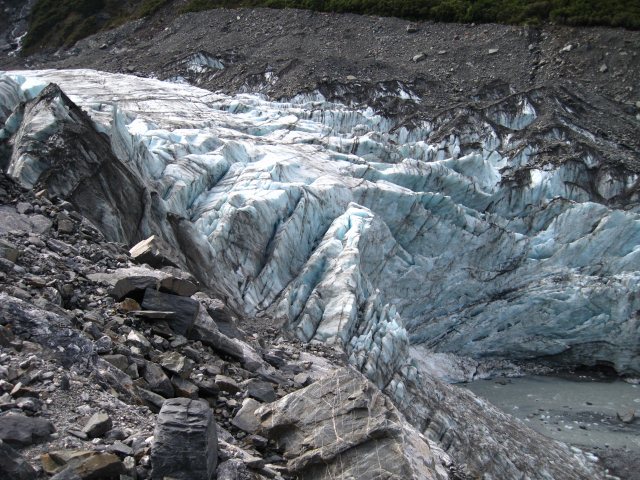
Walking up the glacier was exceptionally cool. It’s the sort of environment I’ve had no exposure to so everything I was seeing was new. Sudden drops in the ice, huge crevasses, soaring peaks that appeared very suddenly (so much of what you see is obscured until you’re right in front of it), huge rocks and boulders from the adjacent valleys (a result of the frequent landslides), danger lurked around every corner. We were glad to have Sam with us. The changes in terrain were very sudden and oftentimes very dramatic. It’s what I’d imagine Earth looked like during its infancy, only with the ice replaced by rock. Everything was so volatile, so unpredictable, there was a lot of uncertainty about the terrain. It was constantly changing, both being formed and destroyed. Sometimes before our very eyes. Because of the unique shape and environment of the Fox and Franz Joseph glaciers, they move at a rate roughly 10 times faster than other valley glaciers around the world. The glacier terminus was noticeably different when we were heading back into town only 9 hours after we had first seen it. Large chunks of ice had fallen off and landed in the river leading away from it. Sam was telling us that sometimes huge house or office building sized chunks of ice fall off, blocking the entire river. The pressure behind the resulting ice dam builds and builds, becoming greater with each passing hour. It builds until the pressure is so strong that it smashes through the ice, creating a violent and unstoppable surge of icy water so big and fast moving that no one could hope to out run or survive it. The last one, only a few years ago, was 35 metres wide and 15 metres high. A person would have no chance. We actually saw a really big rock slide on the adjacent rock face as we were leaving. Thankfully, we were nowhere near it but the sound it generated was thunderous. And not the puny thunder we get in England either, huge, wrath of God thunder, like the world was coming to an end.
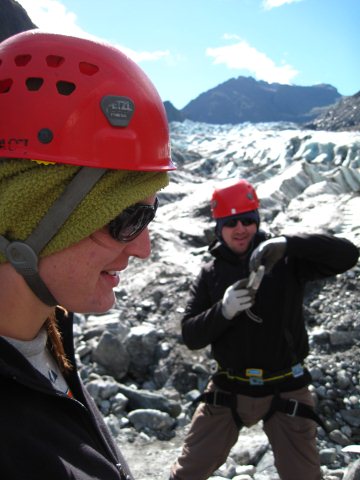
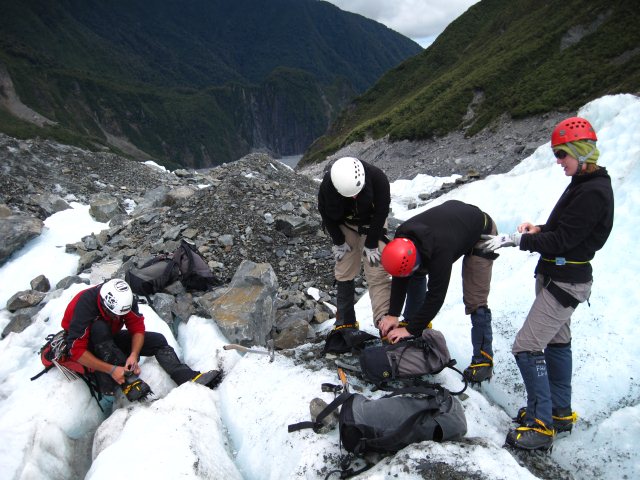
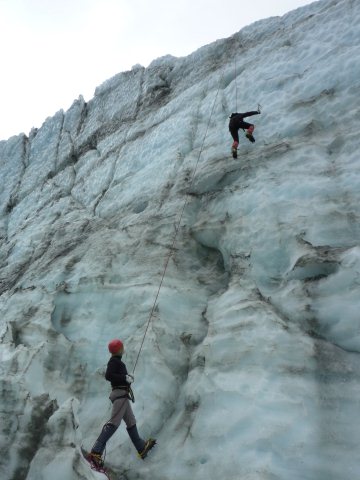
The first climbing spots. Sam started us off slow. It felt very strange kicking something as hard as ice and having two small spikes on the front of your foot support your entire body weight. Getting the technique for the ice axes right was strange too. Flicking your wrist correctly at the end of each swing was the difference between your axe going into the ice and you missing your hold and falling. We understood it quickly because Sam was such an excellent teacher. The first two spots were very straight forward, we didn’t really even need rope to climb them. They were each about 7 metres up and we made short work of them. The next two though were a different story. One was a 25 metre, completely vertical climb with no breaks in the path. All up, all the time, the starting point was a narrow piece of ice with a long drop on the other side. The other, also a 25 metre climb, had a large overhang at the start, you had to overcome this only to be faced with a seriously demoralising metre deep, metre wide break in the path. The only way up was to climb onto the narrow ice ledge at the top of the first part of the wall (being careful to maintain your balance), and using all of your energy to leap over the gap, violently digging your crampons and ice axes into the second ice wall upon contact to continue the climb. After this gruelling effort there was still two thirds of the wall to go. Only, this section had even more overhangs and weaker ice to boot. Climbing it was a physical and mental challenge. In our group of four, I was the only one to successfully scale this wall.
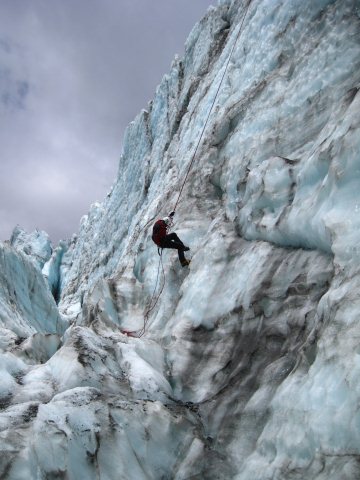

When we were done with those climbs it was around 4:30pm, we started back towards the glacier terminus so that Sam could show us (and lower us down into) a cool sounding crevasse. We’d been in a couple of small ice caves already, one before we even did any climbing but this sounded entirely different. It was about 5 when we were back and Sam had set up the safety system to lower us in. I was the first one in. Just like before, I hooked myself up to the rope and put all my weight back onto the harness. I had both feet up against the ice wall and an ice axe in each hand. Sam slowly fed me more rope as I went down deeper into the ice. I turned my gaze downward and saw how long a drop it was. Now, the last two climbs were really high up, at the top, even half way up, you felt very far from the ground. From that height a fall would likely have meant death or at the very least serious injury. Someone with a fear of heights would probably have been paralysed if they were up there and decided to look down. This though, a fall into this crevasse was certain death. It was a long, possibly 30 metre drop with sharp, jagged rocks at the bottom. It narrowed quite a lot during the descent too, claustrophobics would not have been happy. I decided to look down as I went but it didn’t help me feel better about things so I stopped doing that before long. I let Sam lower me about half way down before telling him I’d had enough. That wasn’t the end though, I still had to climb out and it would not be easy. The ice here was different to what I’d seen so far. The outer layer was very thin and brittle so I was having to kick my boots in really hard. Sore isn’t even the word for how my toes felt afterwards. I was using all my energy to keep my arms going, the axes just weren’t staying in the wall. It was a slow, painstaking process getting back out of that cave. I breathed in a deep sigh of relief when I was on (relatively) solid ground again.
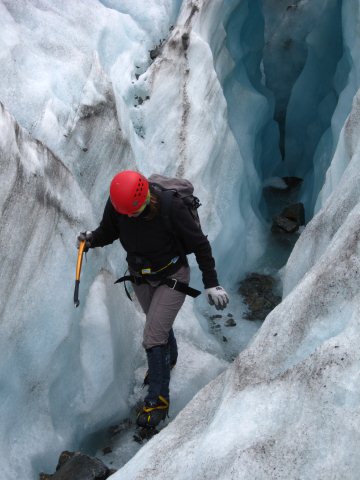
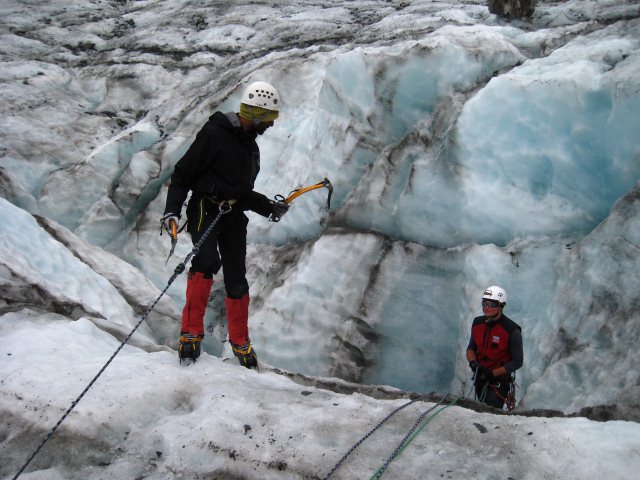

The hike back to the very beginning of the path, down over the stones and boulders, rock hopping over the two small rivers we’d crossed in the morning was unsurprisingly, much more enjoyable downhill than it was up. During that hike back I realised that I enjoyed ice climbing even more than I love scuba diving. It sucks that this is probably going to be an even more expensive hobby to maintain.
 STOP BY FOR POT PIE